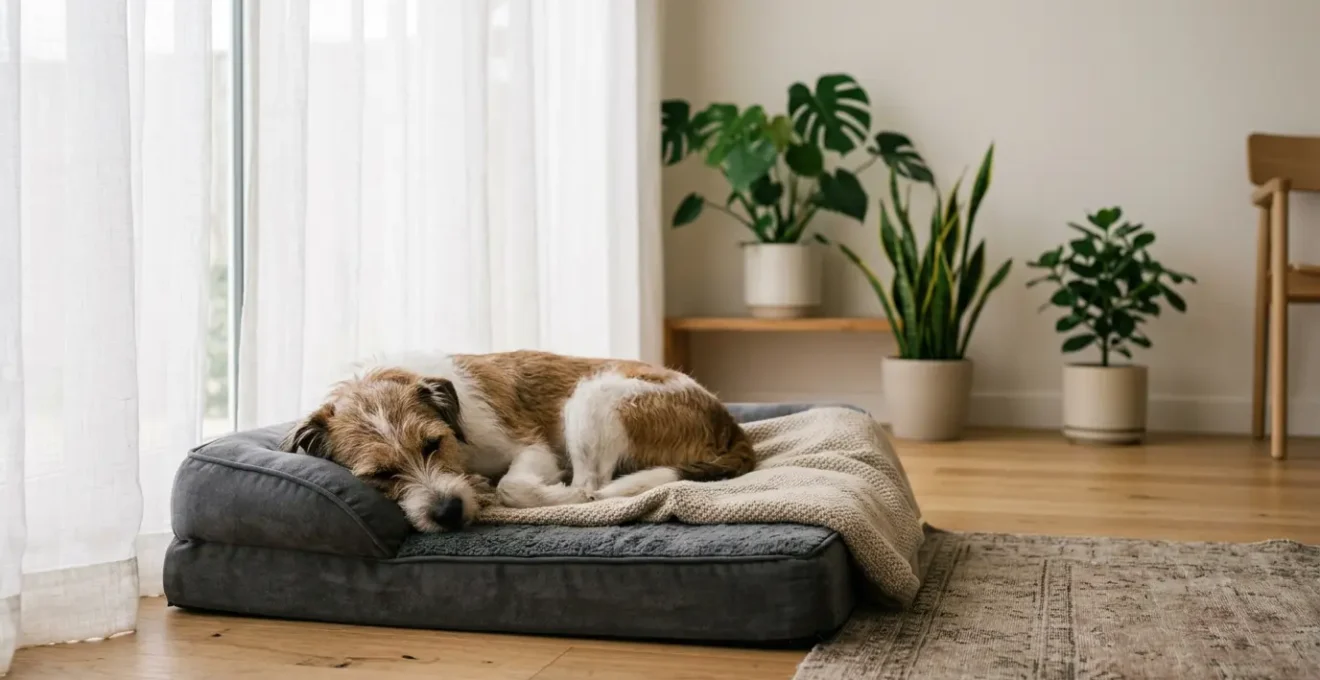
Contrary to popular belief, your new dog’s perplexing behaviors aren’t signs of a “bad dog,” but physiological symptoms of a temporary condition: Kennel Stress Syndrome.
- Chronic exposure to shelter noise and confinement creates a massive buildup of the stress hormone cortisol, leading to behaviors like excessive sleeping, pacing, or barrier frustration.
- Healing is a biological process of “cortisol detox” that requires a specific strategy of controlled decompression, not just love and patience.
Recommendation: Instead of trying to train or “fix” your dog immediately, focus first on creating a quiet, predictable environment that allows their nervous system to reset and heal.
You brought them home. You envisioned joyful greetings, playful afternoons, and cozy evenings. Instead, the dog you met at the shelter seems to have vanished. In their place is a dog who sleeps constantly, hides under the table, paces in circles, or maybe even barks and lunges at the door. It’s confusing, disheartening, and you’re likely asking yourself, “Did I make a mistake?” Your first instinct is to shower them with love, toys, and walks to show them they’re finally safe. But what if that’s the opposite of what they need?
The common advice is to “be patient” and “give them space,” but this often lacks the crucial context. It fails to address the profound physiological storm raging inside your new companion. This isn’t just a simple adjustment period; for many dogs, it’s a recovery from what we can call Kennel Stress Syndrome. The constant noise, lack of control, and unpredictable nature of shelter life floods a dog’s system with cortisol, the primary stress hormone. The behaviors you’re seeing are the direct, physical fallout of this neurochemical imbalance.
This guide will shift your perspective. We will move beyond generic advice and delve into the science behind your dog’s behavior. By understanding that you are managing a physiological recovery, not just a behavioral problem, you will gain the tools and the empathy to truly guide your dog through their healing journey. We will explore why they sleep so much, what “cage aggression” really is, and how a strategy of radical quiet in the beginning is the fastest path to the loving companion you’ve been waiting for.
To help you navigate this delicate period, we’ve broken down the key stages and concepts of your dog’s recovery. This guide will walk you through the science of their stress, provide actionable strategies for creating a healing environment, and help you distinguish between temporary trauma and deeper-seated issues.
Summary: A Compassionate Guide to Healing Kennel Stress
- Why Your Rescue Dog Might Sleep for 3 Days Straight?
- Cage Aggression vs. True Aggression: Will It Continue at Home?
- Spinning and pacing: How to Stop Stereotypic Shelter Behaviors?
- The “Quiet Room” Strategy: Why Immediate Freedom Is Overwhelming?
- Temporary Trauma vs. Genetic Fear: What Can Be Fixed?
- Why the “Five Freedoms” Are No Longer Enough for Modern Pet Dogs?
- Why Is Your Dog Yawning When He Isn’t Tired?
- The “Shutdown” Phase: Why You Should Ignore Your New Dog Initially?
Why Your Rescue Dog Might Sleep for 3 Days Straight?
When your new dog comes home and sleeps for what feels like 72 hours straight, it’s easy to worry. Are they sick? Are they depressed? In reality, this profound exhaustion is often the first, most positive sign of recovery. Think of it not as lethargy, but as a necessary “cortisol detox.” In a shelter environment, a dog’s system is constantly marinated in stress hormones. The body is in a perpetual state of high alert, making true, restorative sleep impossible. In fact, research shows a 33% increase in cortisol levels in dogs after just six weeks in a shelter.
Once your dog is in a quiet, safe home, their brain can finally switch off the alarm bells. The immense need for sleep is the body’s way of clearing out the toxic buildup of cortisol and beginning the healing process. Sleep is when the nervous system recalibrates and mental recovery happens. An Arizona State University study powerfully demonstrated this effect with shelter dog “sleepovers.” It found that even one night away from the shelter significantly reduces cortisol levels in dogs, proving the immediate physiological relief that a safe sleeping environment provides. This deep sleep is a sign that their body finally feels secure enough to let its guard down.
So, instead of trying to coax them out to play, embrace this sleepy phase. Provide a comfortable, quiet bed in a low-traffic area and let them rest. You are not being ignored; you are witnessing the very first step of their journey back to a balanced, healthy state. This is the foundation upon which trust and your future relationship will be built. Resisting the urge to “do something” and simply allowing them to sleep is one of the most compassionate acts you can perform for your new companion.
Cage Aggression vs. True Aggression: Will It Continue at Home?
One of the most frightening behaviors an adopter can witness in a shelter is a dog that barks, lunges, and snarls at the front of its kennel. This is often labeled “cage aggression,” leading many to fear the dog is inherently aggressive. However, in most cases, this is not true aggression at all. It is a phenomenon called barrier frustration, a direct symptom of Kennel Stress Syndrome. As a behaviorist, I see it as thwarting-induced arousal: a physiological stress response, not a character flaw. It’s an explosion of frustration from being physically prevented from performing a motivated behavior, like greeting a person or another dog.
The science backs this up. Neurochemical research reveals that dogs with barrier frustration have cortisol levels roughly double those of calm dogs. Their brains are in a state of extreme arousal, not malice. As the Maddie’s Fund Research Team explains in their work on long-term housing, this behavior is a predictable outcome of the environment:
Barrier frustration behaviors exemplify the general concept of ‘thwarting’: the physical prevention of an animal behaving as it is highly motivated to behave. Physiological stress responses and behaviors like agitation, barking, and aggression can all be reliably predicted by thwarting scenarios.
– Maddie’s Fund Research Team, Maddie’s Fund – Behavior Problems and Long Term Housing
This image helps visualize the internal conflict a dog experiences in a kennel environment, where their natural social instincts are constantly triggered but physically blocked, leading to intense frustration.
The wonderful news is that because this behavior is tied to the barrier, it often disappears entirely once the dog is in a home. Without the kennel door acting as a source of intense frustration, the trigger for the “aggressive” display is gone. While it’s wise to manage introductions to new people and places carefully, you can be confident that the dog you saw in the kennel is very likely not the dog you will have in your living room.
Spinning and pacing: How to Stop Stereotypic Shelter Behaviors?
Does your new dog pace relentlessly back and forth? Do they spin in tight circles, chase their tail, or obsessively lick a spot on their leg? These are known as stereotypic behaviors, and they can be deeply unsettling to watch. It’s tempting to see them as “bad habits” or signs of madness, but it’s more compassionate to view them as neurochemical echoes of their time in the shelter. When a dog is confined to a small space with little to no stimulation, their brain seeks an outlet for pent-up physical and mental energy. These repetitive motions become a coping mechanism, a way to self-soothe in an unbearable environment.
Over time, these behaviors carve a sort of neurological rut in the brain. The dog isn’t consciously choosing to spin; the behavior has become a compulsive, almost automatic response to stress or even boredom. The key to stopping them is not to punish the behavior—which would only add more stress—but to make that neurological pathway obsolete. You do this by enriching their new world with better options. This includes structured walks, puzzle toys, training games, and chews. By providing healthy outlets for their mind and body, you help their brain build new, positive pathways.
Patience is paramount. As the dog’s system undergoes its cortisol detox and they get more restorative sleep, the urge to perform these behaviors will naturally decrease. Research from Utrecht University demonstrates that as dogs adapt to a less stressful environment, their sleep quality improves dramatically, showing that dogs sleep 72-92% of the night, with increased sleep after just two weeks indicating significant stress recovery. This mental healing is what ultimately allows those neurochemical echoes to fade. You are not just stopping a spin; you are helping to rewire a brain for a life of calm and confidence.
The “Quiet Room” Strategy: Why Immediate Freedom Is Overwhelming?
Your home is a palace compared to a shelter kennel, so your first instinct is to give your new dog complete freedom to explore every inch of it. But for a dog recovering from Kennel Stress Syndrome, this well-intentioned gift can be incredibly overwhelming. A brain that has been on high alert for weeks or months cannot process that much new information, space, and choice all at once. The sudden sensory overload can paradoxically increase anxiety rather than relieve it. This is why the “Quiet Room” strategy, a core tenet of controlled decompression, is so effective.
The goal is to make your dog’s new world small, predictable, and calm. For the first few days or even weeks, confine the dog to one or two quiet rooms of the house, using baby gates or closed doors. This creates a safe “home base” where they can learn the sounds and smells of their new life without feeling the need to be constantly vigilant. It allows their nervous system to settle and the cortisol detox process to proceed uninterrupted. This quiet period is not about isolation; it’s about providing sanctuary. Calm, quiet interaction is highly beneficial. A controlled study found that just 45 minutes of calm human interaction on the second day in a new environment significantly reduces a dog’s cortisol levels by the third day.
By intentionally limiting their space, you are giving them the gift of predictability. They learn that nothing scary will jump out from another room, and they can finally relax. This initial period of structure lays the groundwork for a confident dog who sees you as a source of safety. Only once the dog is consistently calm and relaxed in their smaller space should you gradually start introducing them to the rest of the house, one room at a time.
Action Plan: Creating a Decompression Safe Space
- Designate a Den: Choose a low-traffic area of your home (a spare bedroom or quiet corner of the living room) and set up a comfortable crate or bed with soft bedding and a few safe toys.
- Manage the Environment: Use baby gates to restrict access to the rest of the house. Minimize visitors and keep noise levels (TV, music) low during the initial adjustment period.
- Choose Quiet Walks: Find walking locations away from busy dog parks or crowded streets. A quiet neighborhood street or a secluded trail is ideal for sniff-focused, low-pressure walks.
- Provide Orthopedic Support: Ensure the bedding is appropriate for your dog’s size and age. An orthopedic bed can provide significant physical comfort, which aids in mental relaxation.
- Practice Zero-Pressure Interaction: Never scold or force interaction during this phase. Sit quietly in the room with them, read a book, and let them approach you on their own terms.
Temporary Trauma vs. Genetic Fear: What Can Be Fixed?
As you watch your new dog tremble, hide, or react fearfully, a chilling question may cross your mind: Is this permanent? Is my dog “broken”? It’s a natural fear, but as a behaviorist, I can offer significant hope. The vast majority of the fear-based behaviors seen in newly adopted dogs are the result of temporary, environmental trauma, not deep-seated genetic flaws. Kennel Stress Syndrome can make a normally confident dog appear terrified, but once the environmental stressors are removed, their true personality can emerge.
Scientific evidence strongly supports the idea that these changes are reversible. One study tracking stress hormones in shelter dogs found that while cortisol levels increase by one-third after six weeks in a shelter, measurements six weeks and six months after adoption show cortisol levels moving back toward admission values. This is powerful proof that a change in environment can literally reverse the physiological impact of stress. Your loving, quiet home is the antidote to the shelter’s chaos.
Furthermore, research increasingly shows that environment and experience play a far greater role in behavior than genetics, even for traits like aggression. It’s a comforting thought, backed by data:
A study covering 78 breeds found that while 11 genetic markers were associated with behavior, aggression had more to do with a dog’s environment and experiences than genetics. Any dog can develop barrier frustration if conditions are right.
– Research team, ScienceInsights – Barrier Aggression Research
While true genetic shyness does exist, it’s far less common than situational fear. The best approach is to assume your dog’s issues are environmental and treatable. By providing a safe, predictable home and focusing on controlled decompression, you give your dog the best possible chance to shed the weight of their past and show you who they truly are. Most of the time, the resilient, loving dog you hoped for is in there, just waiting for their nervous system to feel safe enough to come out.
Why the “Five Freedoms” Are No Longer Enough for Modern Pet Dogs?
For decades, animal welfare has been guided by the “Five Freedoms”: freedom from hunger and thirst; from discomfort; from pain, injury, or disease; from fear and distress; and freedom to express normal behavior. These are a crucial baseline for any animal’s care, ensuring their basic survival needs are met. When you bring a rescue dog home, you are instantly providing these freedoms. However, for a dog recovering from the trauma of Kennel Stress Syndrome, simply meeting these basic needs is not enough. We must go further, into the realm of positive welfare and psychological agency.
A dog who has lived in a shelter has experienced a profound loss of control over their life. Their days are dictated by schedules they don’t understand, surrounded by noises they can’t escape. This can lead to a state of “learned helplessness.” Therefore, the most powerful healing you can offer is to give them back a sense of choice and control. This is the “Sixth Freedom”: the freedom to have agency. It means creating an environment where their choices matter. This can be as simple as letting them choose which toy to play with, which direction to go on a walk, or whether to interact with you or rest in their bed.
The quality of the new environment matters immensely. It’s not just about escaping a bad situation, but about entering an actively good one. For instance, comparative shelter research indicates a 25% reduction in cortisol for dogs moving from high-stress shelters to foster homes, versus only a 12% reduction for those already in lower-stress facilities. This shows that the *degree* of positive change is what drives recovery. Your home must be more than just “not a shelter”; it must be a place of active enrichment and choice, a place where the dog can learn that their actions have positive consequences. This is the foundation of building a confident, resilient companion.
Why Is Your Dog Yawning When He Isn’t Tired?
You’re sitting quietly with your new dog, and they let out a huge, jaw-stretching yawn. They haven’t been sleeping, so what does it mean? A yawn, along with other subtle signals like lip licking, turning their head away, or a “shake off” as if they’re wet, is a classic example of a calming signal or displacement behavior. These are not random actions; they are a vital part of your dog’s communication toolkit, especially when they are feeling stressed, conflicted, or uncertain. In essence, your dog is saying, “This situation is a little bit much for me right now,” or trying to de-escalate a perceived social pressure.
When your dog yawns at you, they aren’t being rude or bored. They might be processing the stress of being in a new place or feeling a bit overwhelmed by your direct stare or proximity. It’s their polite way of managing their own internal emotional state. Recognizing these subtle cues is like learning a new language—the language of canine stress. Instead of ignoring them, see them as valuable information. When you see a yawn or a lip lick, you can respond by softening your own body language: turn slightly to the side, avoid direct eye contact, or give the dog a little more physical space. This shows them that you understand their discomfort and are not a threat.
Learning to spot these early, low-level signs of stress allows you to intervene before the stress escalates into more overt behaviors like barking, growling, or trying to flee. It empowers you to be a more responsive and supportive guardian during their delicate decompression period. The following table breaks down some of the most common stress signals you might observe.
This table, based on common canine behavior guides, outlines the key signals that indicate your dog is experiencing stress, even in subtle ways. Paying attention to these, as noted in a comprehensive guide to kennel stress, can help you better understand your dog’s emotional state.
| Stress Signal | Physical Manifestation | Underlying Cause |
|---|---|---|
| Excessive Yawning | Frequent yawns without tiredness | Emotional conflict processing |
| Lip Licking | Repeated tongue flicks | Displacement behavior |
| Panting | Heavy breathing without exercise | Stress-induced arousal |
| Freezing | Sudden stillness | Overwhelm response |
Key takeaways
- Your rescue dog’s challenging behaviors are often physiological symptoms of “Kennel Stress Syndrome,” caused by a buildup of stress hormones.
- The initial phase of extreme sleeping is a positive sign of “cortisol detox,” a necessary part of their nervous system’s recovery.
- Creating a small, quiet, and predictable “safe zone” is more effective for decompression than giving them immediate freedom in the whole house.
The “Shutdown” Phase: Why You Should Ignore Your New Dog Initially?
It is perhaps the most counter-intuitive advice you will receive as a new adopter: for the first few days, largely ignore your dog. This doesn’t mean neglecting their needs, but rather, giving them the gift of no social pressure. After the trauma of abandonment and the chaos of a shelter, many dogs are desperate for security. If you immediately shower them with intense affection and attention, you risk fostering an insecure, overly-dependent attachment. As behavior experts Borchelt & Voith noted in their foundational research:
Dogs who have been abandoned or lost their owners may develop overly intense and insecure attachments to subsequent owners, which is why initial space is crucial.
– Borchelt & Voith, Maddie’s Fund – Separation Anxiety Research
By being a calm, quiet presence in the background, you allow the dog to observe you from a safe distance and learn that you are not demanding or threatening. You become a stable, predictable part of the environment. This “ignoring” phase allows them to settle at their own pace and helps prevent the development of future separation anxiety. They learn to be calm in your presence without needing your constant focus.
This initial hands-off period aligns perfectly with the widely recognized “3-3-3 Rule” of rescue dog adjustment. This framework provides a helpful timeline for managing expectations. The first 3 Days are the “shutdown” phase, where the dog is overwhelmed and physiologically decompressing. The first 3 Weeks are when they start to settle in, learn the routine, and let their personality begin to emerge. The first 3 Months are when they finally start to feel truly at home and build deep, lasting trust. Understanding this timeline helps you appreciate that the dog you have on day one is just a shadow of the companion they will become if you grant them the patience and space to heal.
By understanding the science behind Kennel Stress Syndrome and applying these compassionate, patient strategies, you are not just helping your dog adjust—you are guiding them through a profound healing process. Your role in these first few weeks is that of a calm, steady caretaker, creating the safe harbor they need to let the storm inside them pass. This is the foundation for a lifetime of trust and companionship.
Frequently Asked Questions About Healing a Rescue Dog
Why do shelter dogs need more than just food and shelter?
While food and shelter are essential (part of the “Five Freedoms”), they only address basic survival. For psychological well-being, especially after the stress of a shelter, dogs need a sense of control over their environment. Clicker training, for example, gives dogs a feeling of agency and helps them build confidence in what is otherwise a stressful and unpredictable world.
How does choice impact dog welfare?
Providing choice is critical for reducing stress and improving welfare. In a shelter setting, simply having a crate within a run where a dog can choose to retreat creates a positive association through a “contrast effect”—it’s a safe space compared to the chaotic open area. This small measure of control over their personal space can significantly lower stress levels.
What enrichment goes beyond the Five Freedoms?
Modern animal welfare focuses on enrichment that stimulates a dog’s mind and gives them purpose. This goes beyond just providing food and includes things like puzzle toys, scent work, and positive reinforcement training. The fields of environmental stimulation and behavioral rehabilitation are crucial for improving a dog’s quality of life and ultimately increasing their chances of successful, permanent adoption.