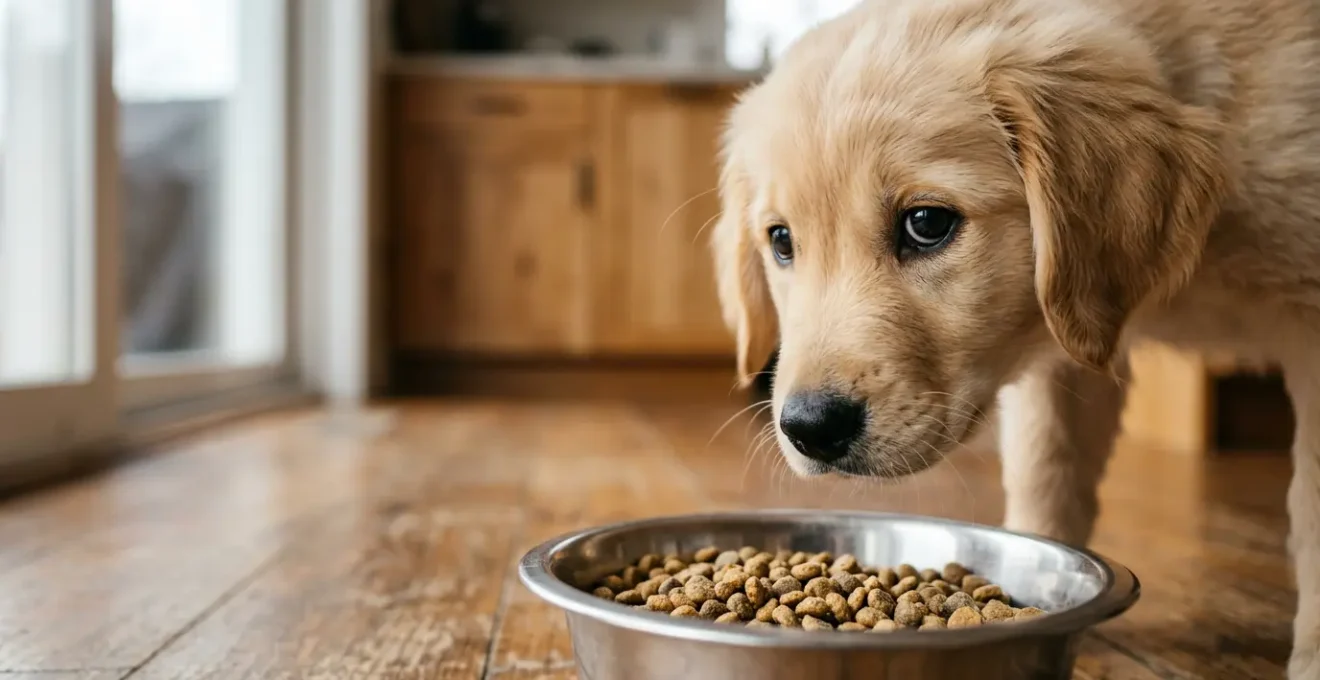
Choosing the right puppy formula is the single most impactful decision you’ll make for their long-term health and behavior.
- Key nutrients like DHA directly program a puppy’s brain for better trainability and emotional stability.
- Controlling growth speed, especially in large breeds, is more important for skeletal health than simply providing calcium.
Recommendation: Focus on a food’s nutritional blueprint—its ratios and sources—not just the ingredient list, to build a resilient, healthy adult dog.
Walking into the pet food aisle as a new puppy owner can be overwhelming. The sheer volume of bags, all promising a perfect start in life, can create a sense of decision paralysis. You’ll hear common advice: “make sure it has DHA,” or “get a large-breed formula.” While true, this advice only scratches the surface. As a pediatric veterinarian, I want to reframe this choice for you. You are not just buying food; you are the architect of your puppy’s future health. Every meal is an opportunity to lay down a robust biological blueprint for a lifetime of well-being.
The first few months of a puppy’s life are a period of explosive development. Their brain, skeleton, and immune system are being built from the ground up. The nutrients you provide are the raw materials for this construction. This article moves beyond the marketing claims on the bag to reveal the science behind a truly foundational puppy diet. We’re not just looking at ingredients; we’re looking at how those ingredients build a healthier, more trainable, and more resilient dog. We will explore the critical role of specific fatty acids in building a better brain, why slower growth is often better for bones, and how early nutrition can program your puppy’s body for a lifetime of health.
This guide breaks down the most critical nutritional considerations into clear, actionable principles. Consider this your veterinarian-led tour of what truly matters when building your puppy’s diet from the ground up.
Summary: A Vet’s Blueprint for Puppy Nutrition
- Why Is DHA Essential for Your Puppy’s Trainability?
- 3 Meals or 4: How to Read Calming Signals to Prevent Dog Bites During Play?
- The “Slow Growth” Plan That Saves Giant Puppies From Pain
- Wet Food vs. Kibble: Which Helps Soothe Teething Pain Better?
- How to Introduce Solids to Weaning Puppies Without Digestive Upset?
- The “Vulnerability Gap”: Why Puppies Get Sick Despite First Shots?
- The 16-Week Flavor Rule That Prevents Picky Eating for Life
- Which Dog Vaccinations Are Absolutely Essential for Your Area?
Why Is DHA Essential for Your Puppy’s Trainability?
When we talk about puppy intelligence, we often think of breed traits. But as a veterinarian, I can tell you that a significant portion of a puppy’s ability to learn is directly fueled by nutrition. At the forefront of this is an omega-3 fatty acid called Docosahexaenoic acid (DHA). Think of DHA as the primary construction material for your puppy’s brain, or what I call “neuro-scaffolding.” It is a vital component of brain tissue and the retina, and its presence is directly linked to cognitive function and trainability.
The developing brain is a whirlwind of activity, forming millions of neural connections per second. DHA is a key building block for this process, as explained by researchers at the Purina Institute:
Docosahexaenoic acid (DHA), an omega-3 fatty acid, is a key part of gray and white matter in the brain, both of which are critical for memory and learning. DHA is concentrated in neural membranes and is vital for nerve signal transmission. It’s also a component of the myelin sheath, which is essential for nerve signal conduction. The developing brain needs adequate levels of DHA to reach its full potential; insufficient levels are associated with poor neural and visual development.
– Purina Institute, Brain Development Research
This isn’t just theory; it has been proven in practice. One landmark study conducted by IAMS on Beagle puppies demonstrated this connection clearly. Puppies whose mothers were fed a diet enhanced with DHA, and who continued on that diet, were significantly more successful in learning tasks. They consistently outperformed puppies on a typical-DHA diet in a maze test, confirming that higher DHA levels directly translate to improved trainability. The impact is quantifiable, as Purina’s research demonstrates that puppies supplemented with DHA can solve complex problems like maze tests up to 25% faster. For a new owner struggling with house training or basic commands, this nutritional advantage is a game-changer.
3 Meals or 4: How to Read Calming Signals to Prevent Dog Bites During Play?
This question is more profound than it appears. It’s not just about scheduling; it’s about managing your puppy’s internal state to foster emotional stability. A puppy’s mood, energy, and ability to control its impulses (like mouthiness during play) are directly tied to its blood sugar levels. Frequent, smaller meals help keep these levels stable, preventing the “hangry” irritability that can lead to over-arousal and unwanted biting.
For very young puppies (6-12 weeks), four meals a day is often ideal. This provides a constant stream of energy, supporting their rapid growth and maintaining a stable mood. As they mature, you can transition to three, and then two, meals. This schedule isn’t arbitrary; it’s a tool for managing their physiological and behavioral development. A hungry puppy is a cranky puppy, one less able to process learning or heed your corrections during a game of fetch. A well-fed puppy with stable blood sugar is calmer, more focused, and better equipped to learn bite inhibition.
Understanding this connection helps you interpret your puppy’s signals. Is that frantic nipping a sign of aggression, or is it a cry for energy because their last meal was six hours ago? The following table provides a general guideline for how feeding frequency impacts a puppy’s stability.
| Age Range | Meals Per Day | Behavioral Benefits | Blood Sugar Stability |
|---|---|---|---|
| 6-12 weeks | 4 meals | Reduced irritability, better impulse control | Most stable |
| 3-6 months | 3 meals | Consistent energy for training | Good stability |
| 6-12 months | 2 meals | Mature feeding pattern | Adequate for most puppies |
By providing a consistent feeding schedule, you create a predictable world for your puppy. This predictability reduces anxiety and helps them develop the calm demeanor necessary to learn crucial social skills, like how to play gently without using their teeth inappropriately.
The “Slow Growth” Plan That Saves Giant Puppies From Pain
With puppies, especially large and giant breeds like Great Danes or Mastiffs, our instinct is to fuel their incredible growth. We see them getting bigger every day and assume they need a massive influx of calories and nutrients. However, this is one of the most dangerous myths in puppy nutrition. For these breeds, faster growth is not better growth; in fact, it’s a direct path to developmental orthopedic diseases like hip dysplasia and osteochondritis dissecans (OCD).
The goal is not to get them to their adult size as quickly as possible. The goal is a “slow growth” plan. This means feeding a diet specifically formulated for large-breed puppies, which is lower in calories, fat, and, most critically, calcium than standard puppy food. Forcing rapid growth puts immense stress on a puppy’s immature skeletal frame. Their bones grow too fast for the supporting cartilage and soft tissues to keep up, leading to painful and often permanent joint problems. As a leading veterinary nutritionist explains, this is a major concern.
Overfeeding large and giant-breed puppies is particularly concerning. If these large dogs grow too quickly, it could lead to developmental orthopedic diseases. Large and giant breeds should be fed targeted levels of calories and minerals to support a moderate growth rate throughout growth and development and even into adulthood.
– Dr. Martha Cline, DVM, DACVIM (Nutrition), Purina Pro Club
A crucial part of this slow-growth plan is the precise balance of minerals. It’s not just about limiting calcium; it’s about maintaining the correct ratio of calcium to phosphorus. This ratio is the bedrock of healthy bone formation. Too much calcium can interfere with normal cartilage development, and an improper ratio can hinder mineral absorption. Research shows the ideal calcium-to-phosphorus ratio for giant breed puppies should be maintained between 1.1:1 to 1.5:1. Choosing a food that adheres to this strict window is one of the most important things you can do to protect your large-breed puppy from a lifetime of pain.
Wet Food vs. Kibble: Which Helps Soothe Teething Pain Better?
The teething phase, typically between three and six months of age, can be a trying time for both you and your puppy. As their adult teeth push through, their gums become sore, inflamed, and sensitive. This discomfort can cause them to lose their appetite, become irritable, or turn into a tiny chewing machine that targets your furniture and fingers. While we often focus on providing safe chew toys, diet can play a significant role in providing relief.
During this period, hard, crunchy kibble may be painful for your puppy to eat. This is where the texture of their food becomes a therapeutic tool. Wet food, with its high moisture content and soft texture, is far gentler on sensitive gums. It requires minimal chewing pressure and the coolness of the food can provide a soothing sensation. You can even take this a step further by freezing portions of wet food in a puzzle toy, creating a long-lasting, puppy-safe “teething popsicle.”
If you prefer to feed kibble, you don’t have to switch completely. Simply moistening your puppy’s dry food with warm water for 5-10 minutes before serving can make a world of difference. This softens the kibble, making it easier to eat without sacrificing the nutritional profile of their primary diet. It’s a simple adjustment that can ensure they continue to get the calories and nutrients they need for growth, even when their mouth is sore.
| Food Type | Moisture Content | Teething Benefits | Serving Tips |
|---|---|---|---|
| Wet Food | 75-85% | Soft texture, hydrates gums, reduces inflammation | Can be frozen in puzzle toys for added relief |
| Moistened Kibble | 25-35% | Softer than dry, maintains some texture | Soak in warm water for 5-10 minutes |
| Dry Kibble | 10-12% | May be too hard for sensitive gums | Choose smaller, smoother pieces for teething puppies |
By being mindful of food texture during this sensitive phase, you can provide significant comfort and prevent feeding from becoming a negative experience. This helps maintain a positive association with mealtime and supports their overall well-being.
How to Introduce Solids to Weaning Puppies Without Digestive Upset?
The transition from mother’s milk to solid food is one of the most delicate moments in a puppy’s early life. Their digestive system is immature and highly sensitive. A sudden change can easily lead to gastrointestinal upset, including diarrhea, vomiting, and refusal to eat. The secret to a successful weaning process is a slow, gradual introduction that allows their gut to adapt. This process, spanning 7 to 10 days, is about progressively changing the food’s texture from a liquid to a solid.
You begin by creating a “gruel” or “porridge” by mixing a high-quality puppy kibble with a milk replacer or warm water. Initially, the mixture should be very soupy, more liquid than solid. You’ll offer this to the puppies several times a day. As they get accustomed to it, you gradually decrease the amount of liquid and increase the amount of kibble over several days. This slow shift in consistency gives the puppy’s digestive tract time to start producing the enzymes needed to break down more complex food.
As the visual above demonstrates, the progression is key. You’re moving from a liquid consistency to a thick gruel, then to a mashed texture, and finally to just moistened kibble. Rushing this process is the number one cause of digestive issues during weaning. It’s also beneficial to start a puppy-specific probiotic a few days before you introduce the first gruel. This helps seed their gut with beneficial bacteria, creating a healthier and more resilient digestive environment to handle the new food. This methodical approach ensures a smooth transition, setting the stage for a lifetime of good digestive health.
The “Vulnerability Gap”: Why Puppies Get Sick Despite First Shots?
One of the most confusing and frightening experiences for a new puppy owner is when their recently vaccinated puppy gets sick. “But he just had his shots!” is a common, panicked cry I hear. The answer often lies in a critical period known as the “vulnerability gap.” When a puppy is born, it receives maternal antibodies (Maternally Derived Antibodies, or MDAs) from its mother’s milk. These antibodies provide temporary, “passive” immunity. However, these maternal antibodies begin to wane between 6 and 16 weeks of age.
Vaccinations work by stimulating the puppy’s own immune system to create its own “active” immunity. The problem is that if maternal antibodies are still present at a high level, they can neutralize the vaccine, rendering it ineffective. But if they have dropped too low, the puppy is left unprotected until the vaccine can kick in. This period—when maternal protection is fading but the puppy’s own immunity isn’t yet strong enough—is the vulnerability gap. This is precisely why nutrition is so critical. A strong nutritional foundation can help bridge this gap. As research indicates that approximately 70-80% of the immune system resides in the gut, a healthy digestive system is paramount for a robust immune response.
This is where nutrients like DHA come back into the picture, not for brain health, but for immune function. A compelling study on Beagle puppies showed that those fed a diet enhanced with DHA had a stronger immune response to their rabies vaccination. This demonstrates that specific nutrients can actually make vaccines work better, helping the puppy’s body build its own defenses more effectively and close the vulnerability gap faster. Choosing a formula rich in immune-supportive nutrients is like giving your puppy’s immune system the best tools possible to navigate this treacherous period.
The 16-Week Flavor Rule That Prevents Picky Eating for Life
Picky eating in adult dogs can be a source of immense frustration for owners. Many assume it’s just a behavioral quirk, but often, the foundation for it is laid in the first four months of life. There is a critical window of “flavor programming” that occurs when a puppy’s brain and palate are at their most receptive. What a puppy is exposed to and learns to enjoy before 16 weeks of age can shape its food preferences for the rest of its life.
The urgency of this window is underscored by the speed of brain development. As puppies acquire 70 percent of their adult brain mass by 6 weeks of age and 90 percent by 12 weeks, their sensory systems are rapidly creating a map of what is “safe” and “good” to eat. If a puppy is only ever fed a single protein source (like chicken) during this entire period, its brain may code other flavors (like fish or lamb) as foreign and potentially undesirable later in life. This is how a picky eater is born.
The solution is a safe and structured flavor rotation. This doesn’t mean chaotically switching brands, which can cause digestive upset. Instead, it involves sticking with a single, high-quality brand that offers different protein varieties (e.g., chicken, lamb, fish formulas). Between 8 and 16 weeks, you can systematically introduce these different proteins. For example, you might feed the chicken formula for two weeks, then switch to the lamb formula for two weeks, and so on. This exposes their developing palate to a range of tastes within a consistent nutritional framework, teaching them that variety is normal and safe. This simple strategy of nutritional programming can prevent years of future frustration and ensure your dog remains a flexible, enthusiastic eater.
Key Takeaways
- DHA is not just a “nice-to-have” ingredient; it is the fundamental neuro-scaffolding for a puppy’s brain, directly impacting trainability.
- For large breeds, controlling the *rate* of growth through a specific diet is more critical for long-term skeletal health than simply fueling size.
- The first 16 weeks are a critical window for “flavor programming,” where controlled exposure to different proteins can prevent picky eating for life.
Which Dog Vaccinations Are Absolutely Essential for Your Area?
This is one of the most important questions you will ask as a new puppy owner, and the answer is deeply personal to your specific location. Core vaccines like rabies, distemper, parvovirus, and adenovirus are generally recommended for all dogs. However, non-core vaccines for diseases like Lyme disease, leptospirosis, or kennel cough depend entirely on your puppy’s risk of exposure, which varies dramatically by region and lifestyle. Therefore, this is not a question the internet can answer for you. It requires a direct conversation with your local veterinarian, who knows the prevalent diseases in your area.
What I *can* tell you, from a nutritional standpoint, is how to make every single one of those essential shots as effective as possible. A vaccine is not a magic shield; it’s a trainer for your puppy’s immune system. And the performance of that immune system is directly tied to nutrition. Giving a vaccine to a poorly nourished puppy is like sending a soldier into training on an empty stomach. You can optimize the process by ensuring your puppy’s body has all the building blocks it needs to mount a strong, effective immune response.
This involves more than just their daily food. It involves a specific protocol around the vaccination event itself. Proper hydration is key, as it helps the body process the vaccine and manage any mild inflammatory response. Nutrients like Vitamin E and omega-3 fatty acids act as antioxidants, helping to protect cells during this period of immune activity. By following a simple nutritional plan before and after vaccination, you support their body and help ensure they get the maximum benefit from each shot.
Your Action Plan: Pre and Post-Vaccination Nutritional Protocol
- One week before vaccination: Increase foods rich in Vitamin E and omega-3 fatty acids.
- Day of vaccination: Add moisture to food (wet food or water-soaked kibble) to boost hydration.
- 48 hours post-vaccination: Continue enhanced hydration and consider probiotic supplementation.
- Monitor appetite closely – a temporary decrease is normal for 24-48 hours.
- Ensure a consistent feeding schedule to support the immune response.
- Avoid introducing any new foods for 5-7 days around vaccination dates to minimize digestive stress.
This strategic approach to nutrition turns vaccination from a simple shot into a fully supported biological event, maximizing protection and reinforcing the foundation of health you are so carefully building.
Armed with this knowledge, your next step is to have a confident conversation with your own veterinarian to select the specific brand and plan that will become the blueprint for your puppy’s vibrant future.