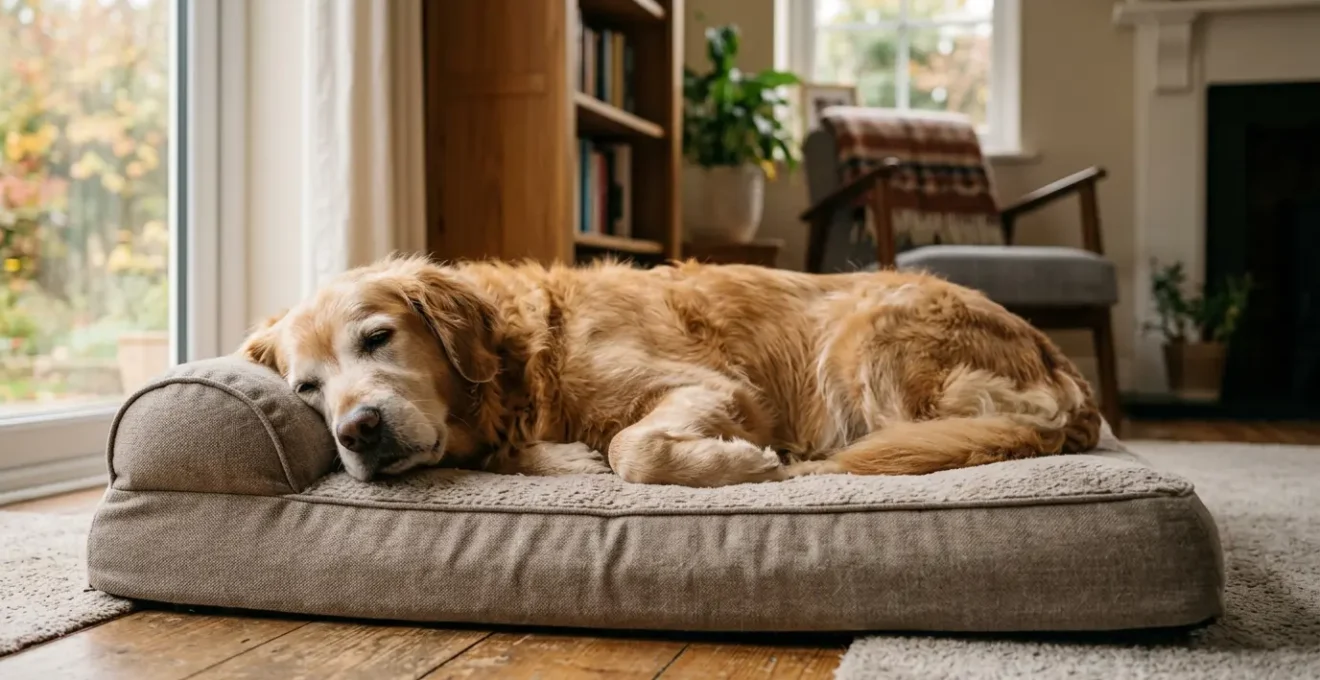
Most “orthopedic” dog beds fail to provide therapeutic support, often making joint pain worse by creating pressure points and instability.
- True support comes from high-density foam (at least 4.5 lbs/cubic ft) that resists “bottoming out” under your dog’s weight.
- Features like waterproof liners and gel-infused foam are not luxuries; they are essential for maintaining the bed’s structural integrity and promoting healing sleep.
Recommendation: Stop evaluating beds on “softness” and start using the “Hand Press Test” to assess the underlying supportive engineering, treating the purchase as a medical investment in your dog’s joint health.
Watching a beloved dog struggle with stiffness and pain is heartbreaking for any owner. You see them hesitate before lying down, hear a soft groan as their joints settle, and notice that slow, careful gait in the morning. Your first instinct is to provide comfort, often by buying a plush, fluffy bed that looks invitingly soft. But what if that well-intentioned purchase is not only failing to help but is actively contributing to their discomfort? The common approach to canine comfort is fundamentally flawed, treating a medical issue—arthritis—with a furniture solution.
The market is flooded with products labeled “orthopedic,” yet most are little more than fiber-filled cushions that collapse under pressure. This creates an unstable, hammock-like surface that forces a dog’s spine and joints out of alignment, creating new pressure points and exacerbating inflammation. The key to improving your dog’s quality of life isn’t about finding a softer bed; it’s about understanding that a true orthopedic bed is not furniture. It is a therapeutic surface, an piece of engineering designed to manage a medical condition. Its purpose is to distribute weight evenly, eliminate pressure points, and facilitate the deep, restorative sleep necessary for the body’s natural healing processes.
This guide moves beyond marketing claims to give you the knowledge of an animal sleep specialist. We will dismantle the myth of the “fluffy” bed, teach you how to physically test a bed’s supportive core, and explain the critical role of materials in temperature regulation and longevity. You’ll learn why a standard bed can ruin a giant breed’s joints and how the right surface can amplify the benefits of joint supplements. It’s time to make an informed, medical-grade decision for your companion’s health.
To help you navigate these crucial considerations, this article provides a detailed breakdown of what truly constitutes a supportive, therapeutic sleep environment for your dog. The following sections will guide you through each aspect of the selection process.
Summary: The Expert’s Guide to Orthopedic Dog Beds
- Why “Fluffy” Beds Are Terrible for Dogs With Hip Dysplasia?
- The “Hand Press” Test: How to Check Quality in the Store?
- Gel-Infused vs. Standard: Avoiding Overheating on Memory Foam?
- Waterproof Liners: Why They Are Non-Negotiable for Senior Beds?
- When to Replace: Signs Your Memory Foam Has Lost Its Bounce?
- Glucosamine in Food vs. Pills: Which Is More Effective for Arthritis?
- Why a Standard Large Bed Will Ruin Your Mastiff’s Joints?
- Puppy or Adult: Who Needs More Than 16 Hours of Sleep per Day?
Why “Fluffy” Beds Are Terrible for Dogs With Hip Dysplasia?
The term “orthopedic” has been so overused in the pet industry that it has lost its meaning. Many owners believe any thick, soft bed qualifies. This is a dangerous misconception, especially for dogs with hip dysplasia, a condition affecting a significant portion of the canine population. In fact, comprehensive data shows that the prevalence of hip dysplasia is 15.56% across all breeds according to the Orthopedic Foundation for Animals. For these dogs, a non-supportive bed is not just unhelpful; it’s actively harmful. “Fluffy” beds, typically filled with polyester fiber, shredded foam, or low-quality egg-crate foam, collapse under weight.
When a dog lies on such a surface, their heaviest points—the hips and shoulders—sink in completely, while the rest of the body is poorly supported. This creates a “hammock effect,” forcing the spine into a curved, unnatural position and putting immense strain on already painful joints. Instead of relieving pressure, these beds create new pressure points and joint instability. An arthritic dog on a fluffy bed must constantly use its own muscles to try and find a stable, comfortable position, preventing true rest and leading to increased stiffness upon waking. A clear sign of an inadequate bed is when a dog chooses to sleep on the hard floor instead; they are instinctively seeking a stable surface that doesn’t contort their body.
A true orthopedic bed does the opposite. It is built with a high-density support core that conforms to the body’s shape while resisting collapse. This provides a level, stable surface that keeps the spine aligned and distributes weight evenly, alleviating pressure on the hips, elbows, and shoulders. The goal is to create a zero-gravity environment for the joints, allowing muscles to relax completely and promoting the deep, restorative sleep crucial for healing.
The “Hand Press” Test: How to Check Quality in the Store?
You cannot judge a bed’s supportive capability by its thickness or softness alone. The most crucial factor is the density and quality of the foam core. A simple, effective way to assess this in person is the “Hand Press” Test. When you’re in a store, don’t just gently pat the bed. Instead, make a fist or use the palm of your hand and press down into the center of the bed with your full body weight. What you’re looking for is resistance. Does the foam compress but stop you from feeling the floor underneath? Or does it “bottom out” instantly, offering no real opposition?
A high-quality, high-density orthopedic foam will yield to pressure to contour to the body, but it will not collapse. If you can feel the hard floor through the foam with this test, a 70-pound dog certainly will. This bottoming out is precisely what happens with low-quality beds, leaving your dog’s sensitive joints pressed against a hard surface with a thin layer of useless foam in between. This test separates true supportive engineering from simple cushioning. It reveals whether the bed has a genuine support core designed to carry weight or if it’s just a decorative pillow.
Clinical Proof: The University of Pennsylvania Study
The impact of a properly engineered bed is not just theoretical. A clinical trial conducted by the University of Pennsylvania on the Big Barker Bed provided scientific evidence. The study showed that using a quality orthopedic bed led to measurable improvements in mobility, a reduction in joint pain severity, and even higher energy levels in large dogs suffering from arthritis. This confirms that the right foam density and support structure have a direct, positive, and medically significant impact on a dog’s quality of life.
As the image demonstrates, the test is about feeling for that crucial point of resistance. The foam should feel substantial and push back against your weight. This tactile feedback is your most reliable indicator of a bed that will provide your dog with the therapeutic support they need to rest comfortably and wake up with less pain and stiffness.
Gel-Infused vs. Standard: Avoiding Overheating on Memory Foam?
High-quality memory foam is the gold standard for orthopedic support due to its unique viscoelastic properties, which allow it to contour perfectly to a body’s shape. However, traditional memory foam has one significant drawback: it is a dense, closed-cell material that can trap body heat. For some dogs, especially those with thick coats or those who naturally run warm, this can lead to overheating, restlessness, and fragmented sleep, defeating the purpose of a therapeutic bed. This is where material innovation becomes critical for comfort.
To combat this issue, leading manufacturers have developed gel-infused memory foam. In this technology, the foam is blended with cooling gel beads or swirls during the manufacturing process. This gel actively draws heat away from the dog’s body and dissipates it, creating a more temperature-neutral sleeping surface. While standard foam can feel warm and sometimes clammy, a gel-infused bed often feels cool to the touch initially and is far more effective at preventing heat buildup throughout the night. This is particularly important because the ideal foam density for support—often specified as at least 4.5 pounds per cubic foot for high-quality orthopedic beds—can exacerbate the heat issue. The gel infusion allows for this necessary density without the thermal downside.
The choice between standard and gel-infused foam depends on your dog and your climate. For a short-haired dog in a cool environment, standard memory foam may be perfectly adequate. But for a heavily coated breed like a Newfoundland or a dog prone to seeking out cool tiles, a gel-infused bed can be the difference between a night of therapeutic rest and a night of uncomfortable tossing and turning.
| Feature | Standard Memory Foam | Gel-Infused Memory Foam |
|---|---|---|
| Temperature Regulation | Can retain body heat | Up to 5x better heat dissipation |
| Initial Comfort | Warm sensation | Cool-to-touch surface |
| Density Support | 3-4 lbs/cubic ft typical | 4.5+ lbs/cubic ft optimal |
| Longevity | 5-7 years average | 7-10 years with proper care |
| Best For | Cool climate dogs | Dogs prone to overheating |
Waterproof Liners: Why They Are Non-Negotiable for Senior Beds?
A waterproof liner is not an optional accessory; it is an absolute necessity for any orthopedic dog bed, especially one for a senior dog. Incontinence, accidents, or even just drool can and will happen. When moisture penetrates the outer cover and reaches the foam core, it triggers a catastrophic and irreversible breakdown of the bed’s supportive structure. It’s a matter of chemistry, not just cleanliness. This is why a simple washable cover is not enough.
As experts in foam technology explain, moisture is the primary enemy of the material. In their technical documentation, Pet Support Systems notes:
Moisture is the primary enemy of memory foam’s chemical structure. It breaks down the viscoelastic polymers, permanently destroying the bed’s supportive properties.
– Pet Support Systems Technical Documentation, Temperature Regulated Orthopedic Dog Beds Guide
Once the foam is compromised, it loses its ability to rebound and provide support. It will become permanently indented, soft, and useless as a therapeutic surface. A high-quality waterproof liner, typically made of a quiet, breathable fabric, sits between the outer cover and the foam core, acting as an impenetrable barrier. This protects your significant investment and ensures the bed continues to provide the necessary joint support for years. Beyond material integrity, there’s also a crucial health consideration. A damp foam core becomes a breeding ground for mold, mildew, and bacteria, which can be harmful to any dog, but especially to a senior with a potentially compromised immune system.
To that end, when selecting a bed, look for materials that are certified for safety. The CertiPUR-US certification, for example, indicates that the foam has been tested and is made without harmful chemicals like mercury, lead, heavy metals, formaldehyde, or regulated phthalates. Choosing certified materials reduces your senior dog’s exposure to toxins that could compound existing health problems, providing peace of mind alongside physical support.
When to Replace: Signs Your Memory Foam Has Lost Its Bounce?
Even a high-quality orthopedic bed has a finite lifespan. Over years of use, the foam’s cell structure will naturally begin to break down, and it will lose its ability to provide therapeutic support. A top-tier bed from a premium manufacturer may come with a warranty for up to 10 years against flattening, but lesser quality beds will fail much sooner. It’s vital to recognize the signs of a worn-out bed, as continuing to use it can be as detrimental as using a cheap, fluffy bed from the start. Your dog’s behavior is often the first and most reliable indicator that their bed is no longer comfortable.
Look for subtle changes in their resting habits. A dog on a failing bed will exhibit increased restlessness, constantly shifting positions throughout the night as they struggle to find a spot that doesn’t cause discomfort. You may notice them groaning more frequently when they lie down or get up, or they might suddenly start preferring the hard floor again. This is a clear signal that the bed is no longer providing relief and may even be causing pain. The foam has likely developed a permanent “divot” or impression where your dog usually lies, meaning it has lost its “bounce” and is no longer pushing back to provide support.
Physically testing the bed every few months is also a good practice. Use the “Hand Press Test” again on the area where your dog sleeps most. If it feels significantly softer than the surrounding foam or bottoms out easily, the bed’s supportive core is compromised. A visible, permanent body impression that doesn’t disappear after your dog gets up is the final, undeniable sign that the bed’s therapeutic life is over. At this point, it has reverted to being just a cushion, and it’s time for a replacement to ensure your dog continues to receive the joint support they need.
Action Plan: Auditing Your Dog’s Current Bed
- Observe Behavior: For one week, note if your dog is restless, groaning, or avoiding their bed. Log any instances of them choosing the floor.
- Perform the Hand Press Test: Press your fist firmly into the center of the most-used area. Can you feel the floor? Note the resistance compared to the bed’s edges.
- Check for Permanent Impressions: Remove the cover and look at the bare foam. Is there a visible, permanent divot where your dog lies? Measure its depth.
- Assess the Smell and Condition: Check the foam for any signs of mildew or a persistent damp smell, indicating the waterproof liner has failed or is absent.
- Make a Decision: If the bed fails two or more of these checks (e.g., it bottoms out and your dog is restless), it is no longer therapeutic and should be replaced.
Glucosamine in Food vs. Pills: Which Is More Effective for Arthritis?
Managing canine arthritis requires a multi-faceted approach where a supportive bed is the foundation, but other elements like diet and supplementation play crucial roles. With an estimated 80% of dogs over the age of eight suffering from joint issues, many owners turn to supplements like glucosamine and chondroitin. A common question is whether it’s more effective to provide these through specialized therapeutic diets or as separate pills and chews. The answer depends on dosage control, bioavailability, and synergy with your dog’s rest cycle.
Glucosamine administered in pill or chew form allows for precise dosage and timing. Vets often recommend giving the supplement shortly before the dog’s longest rest period. This is where the synergy with an orthopedic bed becomes powerful. When the dog is resting on a proper therapeutic surface that minimizes joint inflammation, the body is in an optimal state to absorb and utilize the building blocks from the supplement for cartilage repair. The pressure-free environment of a good bed enhances the anti-inflammatory effects of the supplement.
Glucosamine integrated into dog food offers convenience and ensures a steady, consistent intake with every meal. This can be beneficial for maintaining baseline levels of joint support throughout the day. However, it can be harder to control the exact dosage, especially if your dog’s appetite fluctuates. For severe arthritis, a combination approach is often best: a therapeutic diet for maintenance, supplemented by a targeted pill dose before bedtime to maximize the healing that occurs during deep sleep. Ultimately, the most “effective” form is the one you can administer consistently, but timing it to work with a long, comfortable rest on a supportive bed is key to unlocking its full potential.
This table illustrates how different supplements can be timed to work in concert with the healing that happens during quality rest.
| Supplement Form | Best Timing | Synergy with Orthopedic Bed |
|---|---|---|
| Glucosamine Pills | Before longest rest period | Body in low-inflammation state enhances absorption |
| Food-Based Glucosamine | With regular meals | Steady levels support ongoing joint repair during rest |
| Omega-3 Supplements | With evening meal | Anti-inflammatory effects maximize during sleep recovery |
| Combined Approach | Split throughout day | Continuous support works with pressure-free rest |
Why a Standard Large Bed Will Ruin Your Mastiff’s Joints?
For giant breed dogs like Mastiffs, Great Danes, or Irish Wolfhounds, a “large” or “extra-large” bed from a standard retailer is fundamentally inadequate and dangerous to their long-term health. The principles of supportive engineering must be scaled up exponentially to handle their immense weight and size. A bed that works for a 70-pound Labrador will collapse instantly under a 180-pound Mastiff, offering zero orthopedic benefit and actively contributing to the degradation of their joints.
The core issue is, once again, bottoming out. The sheer force exerted by a giant breed’s body will compress standard-density foam completely, leaving their hips, shoulders, and elbows resting directly on the hard floor. This creates intense pressure points, which not only cause pain but can also lead to hygromas (fluid-filled sacs that form over bony prominences), pressure sores, and accelerated arthritic changes. For these dogs, a bed isn’t a luxury; it’s essential medical equipment to prevent gravity from constantly working against their massive frames.
Specialist manufacturers who focus on giant breeds use entirely different engineering specifications.
Engineering for Giants: The Bully Beds Example
Companies like Bully Beds demonstrate the level of engineering required. Their beds are specifically designed to support weights of up to 300 pounds without failure. They achieve this by using a much thicker foam core, often 7 inches or more, composed of multiple layers of varying high densities. The base layer is extremely firm to prevent bottoming out, while a top comfort layer provides the contouring pressure relief. This multi-layer construction is calibrated to handle the specific weight distribution of a giant breed, ensuring that even a 180-pound dog remains fully suspended and supported by the foam, with no part of their body making contact with the floor.
When choosing a bed for a giant breed, you must ignore standard sizing and look exclusively at beds with a specified, tested weight rating that comfortably exceeds your dog’s adult weight. It is a significant investment, but one that is critical for preserving their mobility and quality of life.
Key Takeaways
- A bed’s “softness” is irrelevant; its ability to resist “bottoming out” under weight is the only true measure of orthopedic support.
- Moisture from accidents permanently destroys memory foam’s structure, making a waterproof liner a non-negotiable feature to protect your investment.
- For giant breeds, a standard “XL” bed is insufficient. You must choose a bed specifically engineered and weight-rated for their massive frames to prevent joint damage.
Puppy or Adult: Who Needs More Than 16 Hours of Sleep per Day?
While we often associate orthopedic needs with senior dogs, the importance of high-quality, supportive sleep begins in puppyhood and extends through every stage of a dog’s life. The amount of sleep required varies dramatically with age. Puppies, for instance, need 18-20 hours of sleep per day for proper physical and mental development. Senior dogs also require extended rest, often sleeping 16 hours or more. But beyond the duration, the quality of that sleep is paramount, and it is directly linked to the surface they sleep on. It’s during sleep that the body works to heal and repair itself.
This healing process is most effective during deep, non-REM sleep. As one veterinary expert explains, this is when the body is most active in mitigating joint stress.
Deep, non-REM sleep is when the body actively works to reduce inflammation. A painful, unsupportive bed leads to fragmented sleep, preventing the dog from entering and sustaining this crucial healing state.
– Dr. Jamie Whittenburg, Director of Kingsgate Animal Hospital
For a puppy, a firm, supportive surface ensures their rapidly growing bones and joints are held in proper alignment, which can help prevent future issues. For an active adult dog (who sleeps 12-14 hours), a supportive bed helps them recover from daily activity and preemptively protects their joints from wear and tear. For a senior, it becomes a critical tool for managing pain and maximizing mobility. A dog that cannot enter deep sleep due to the discomfort of a poor bed is being deprived of its natural ability to heal. Therefore, investing in a high-quality, supportive bed from day one is a proactive measure for lifelong joint health.
- For puppies (18-20 hours sleep): Provide firm support during the critical growth phase to ensure proper joint alignment and development.
- For adult dogs (12-14 hours sleep): Maintain consistent support to help them recover from daily activity and prevent future joint problems.
- For senior dogs (16+ hours sleep): Maximize pressure relief with high-density memory foam to manage pain and improve mobility.
- For all stages: Ensure the bed is large enough to allow full body stretching, which is essential for quality REM sleep cycles.
By applying this knowledge, you can move beyond the misleading marketing and make a decision based on engineering, material science, and your dog’s specific medical needs. The next step is to use these criteria to confidently choose a therapeutic surface that will genuinely improve your companion’s comfort, mobility, and overall quality of life.