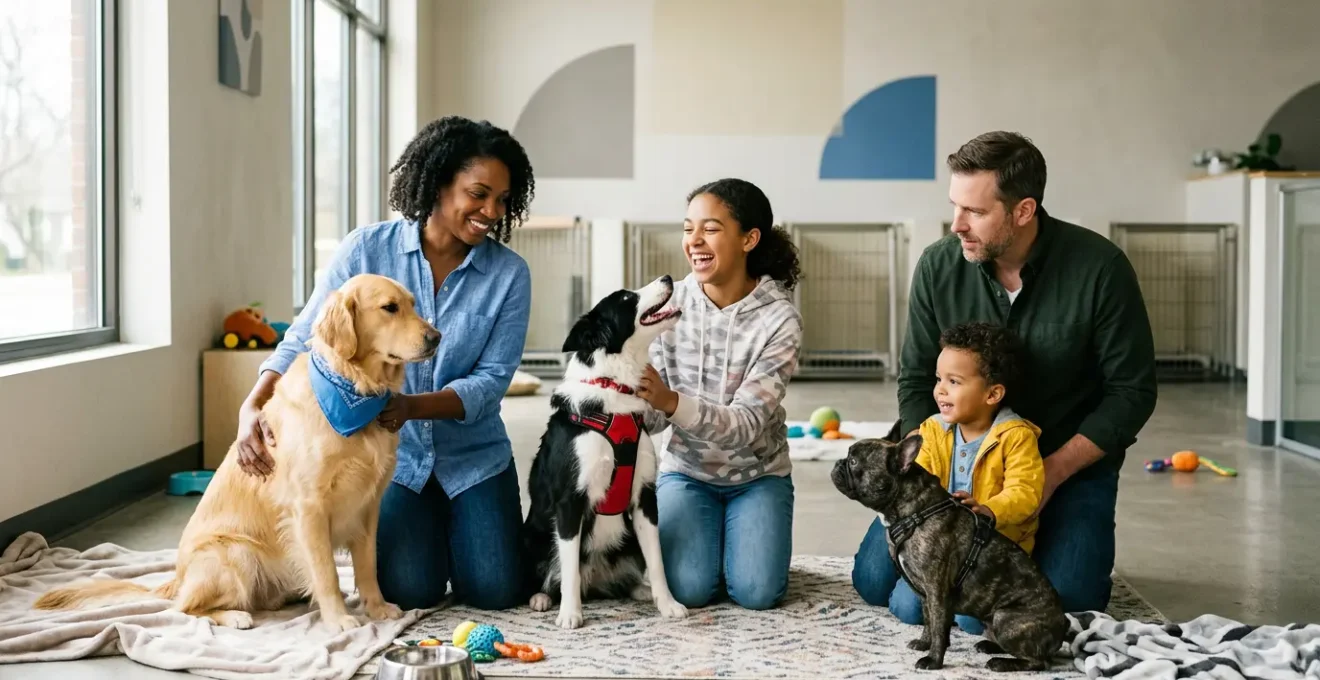
Choosing a dog based on looks or your “ideal” self is the number one cause of a heartbreaking “reality mismatch.”
- True success comes from an honest audit of your actual time, budget, and emotional capacity—not your weekend warrior aspirations.
- Breed genetics and a rescue dog’s history are non-negotiable data points that predict future behavior, not minor details to overlook.
Recommendation: Use this guide as your professional matchmaker to assess your reality *before* you even start searching for a dog.
The image is a powerful one: the perfect dog, a loyal companion trotting happily by your side on a sun-drenched trail or curled up at your feet. This is the dream that fuels the search for a new canine family member. Yet, shelters are filled with the heartbreaking consequences of when that dream collides with reality. Too often, dogs are returned because of a fundamental mismatch between the animal’s needs and the owner’s actual life, not the one they imagined having.
Standard advice often feels generic and unhelpful. You’re told to “consider your activity level” or “think about your living space.” While not wrong, this guidance rarely scratches the surface of the true commitment. It doesn’t quantify the real difference between a 30-minute stroll and the two hours of mental and physical work a working breed requires. It doesn’t translate “needs grooming” into a non-negotiable line item of thousands of dollars and hundreds of hours over a dog’s lifetime.
But what if the entire framework for choosing a dog is flawed? The secret to a successful, lifelong partnership isn’t about finding a dog that fits the person you *want* to be. It’s about conducting an honest, sometimes brutal, self-audit to find a dog that fits the life you *actually live*. This is not about aesthetics; it’s about compatibility. It requires you to act less like a consumer picking a product and more like a professional matchmaker seeking a viable, long-term placement.
This guide is designed to be your objective partner in that process. We will move beyond the platitudes to dissect the non-negotiable realities of dog ownership. We’ll examine the true temporal and financial costs, decode the language used by shelters, and give you the tools to assess your own capacity with unflinching honesty. The goal is simple: to ensure your new companion finds a forever home from day one.
Summary: A Matchmaker’s Guide to Choosing the Right Dog
- Are You Actually Active Enough for a Working Breed?
- Which Breeds Have the Highest Tolerance for Toddlers?
- Poodle vs. Labrador: The Time Cost of Coat Maintenance
- Velcro Dog or Independent Spirit: Which Suits Your Remote Work Setup?
- Apartment vs. House: Which Giant Breeds Are Actually Low Energy?
- Why a “Free” Puppy Costs $2,000 in the First Year Alone?
- Decoding Shelter Euphemisms: What “Needs Only Pet Home” Really Means?
- How to Navigate Shelter Applications to Secure the Right Dog?
Are You Actually Active Enough for a Working Breed?
The most common point of failure in dog ownership is the energy level mismatch. Many people who describe themselves as “active” are, in reality, “active on weekends.” A working breed like a Border Collie, Australian Shepherd, or Husky doesn’t operate on a five-day work week. Their genetic blueprint demands consistent, daily stimulation, and a failure to provide it often results in destructive behaviors like chewing, excessive barking, or restlessness. A long hike on Saturday does not compensate for five days of under-stimulation.
The fantasy of a tireless hiking partner is appealing, but the reality involves a commitment to structured exercise and mental work, rain or shine. High-energy breeds need a job. This doesn’t mean herding sheep, but it does mean engaging in activities like advanced obedience, agility, or daily puzzle-solving games that tax their minds. Breeds with lower energy needs, like a Basset Hound or a Bulldog, are often far happier with shorter daily walks and significant time spent relaxing. The key is an honest self-audit of your *current* lifestyle, not an aspirational one.
Before you fall in love with a high-drive puppy, you must objectively measure your capacity. It’s not about being a “good” or “bad” owner, but an honest one. This self-assessment is the first and most critical step in preventing a reality mismatch that leads to frustration for both you and your dog.
Your Activity Level Reality Check
- Track Your Reality: For one full week, log your actual daily exercise time, not your aspirational goals. Include every walk, run, or outdoor activity.
- Calculate Home Time: Inventory your typical weekday. How many hours are you truly at home and available versus away at work or social commitments?
- Assess Weekend Patterns: Be brutally honest about your weekends. Are you a true “weekend warrior” out from dawn till dusk, or do you balance activity with relaxation and chores?
- Gauge Mental Stimulation Capacity: Can you realistically commit 30+ minutes every single day, separate from physical walks, to dedicated training, puzzle games, or scent work?
- Evaluate Weather Tolerance: Will you enthusiastically walk the dog in pouring rain, snow, or extreme heat? A working dog’s needs don’t pause for bad weather.
Which Breeds Have the Highest Tolerance for Toddlers?
When a dog and a young child share a home, safety is the paramount concern. The common advice is to get a “family-friendly” breed, but this label is often vague. A more effective approach is to understand the genetic predisposition that makes certain breeds more tolerant and resilient in the chaotic environment of a household with toddlers. It’s not just about temperament, but about ingrained physical traits.
For example, over 85% of temperament assessments rate Labrador Retrievers and Golden Retrievers as excellent family pets. The reason goes beyond a friendly disposition. These breeds were developed for a specific job: retrieving waterfowl gently without damaging it. This translates into a genetic trait known as a “soft mouth” and superior bite inhibition. While any dog can bite, these breeds are genetically hardwired to be more careful with their mouths, a significant advantage around unpredictable toddlers. Other breeds known for their patience and sturdiness include Beagles and certain Bulldog types.
This is what an experienced matchmaker looks for: a dog whose historical purpose aligns with the demands of a modern family. However, no genetic advantage replaces the need for vigilant supervision and proper environmental management. It is crucial for the dog to have a designated “get-away space,” like a crate or a separate room, where they can retreat when they feel overwhelmed. Children must be taught to respect this space and never to bother a resting dog. The combination of the right breed and a safe, structured environment is the key to a harmonious home.
As this scene illustrates, creating a safe zone and teaching mutual respect are as important as choosing the right breed. A successful dog-child relationship is actively built through management and training, not just left to chance. Even the most tolerant dog has its limits, and it’s the adults’ responsibility to recognize subtle cues that a dog has had enough and needs a break.
Poodle vs. Labrador: The Time Cost of Coat Maintenance
The decision between a shedding and a “non-shedding” breed often seems simple, but it masks a critical trade-off in both time and money. The term “hypoallergenic” is a misnomer; it typically refers to dogs with hair-like coats that shed minimally, such as Poodles, Bichon Frises, or Yorkshire Terriers. While they save you from constant vacuuming, they introduce a significant and non-negotiable grooming burden—what can be termed the temporal cost of coat care.
A Labrador’s coat requires minimal intervention beyond basic brushing to manage seasonal shedding. In contrast, a Poodle’s coat requires daily brushing to prevent painful mats and professional grooming every 6-8 weeks. This is not an optional luxury; it is a mandatory health requirement. Failure to maintain their coat can lead to skin infections and severe discomfort. Many new owners of doodle-mixes fall victim to the “puppy coat deception,” where a soft, manageable puppy coat transforms into a high-maintenance, mat-prone adult coat that demands expensive and skilled professional care.
This commitment extends far beyond the financial. It’s a recurring appointment in your calendar and a daily task on your to-do list. Before choosing a breed that requires professional grooming, you must honestly assess if you have the budget for a lifetime of care and the discipline for daily maintenance. The following table illustrates the stark difference in long-term investment.
| Aspect | Poodle | Labrador |
|---|---|---|
| Professional Grooming Frequency | Every 6-8 weeks | 2-3 times per year |
| Annual Grooming Cost | $600-$1,040 | $150-$300 |
| 12-Year Lifetime Cost | $7,200-$12,480 | $1,800-$3,600 |
| Daily Maintenance Time | 15-20 minutes brushing | 5 minutes brushing |
| Shedding Level | Minimal | Heavy seasonal shedding |
| Additional Equipment Costs | $200+ for specialized tools | $50 for basic brush and deshedder |
Velcro Dog or Independent Spirit: Which Suits Your Remote Work Setup?
The rise of remote work has changed the landscape of dog ownership. While being home more seems ideal, it introduces a new set of challenges. The critical question is no longer just “how long will the dog be alone?” but “can I actually work with this dog in my home?” This requires a match between your work style and a dog’s need for attention. A “Velcro dog”—a breed that thrives on constant human contact, like a Vizsla or Italian Greyhound—may struggle immensely if you need long, uninterrupted focus blocks, leading to separation anxiety even when you’re in the next room.
Conversely, a more independent breed, such as a Shiba Inu or an Akita, might be better suited to a remote work environment, content to entertain themselves for periods. However, “independent” does not mean “no work.” It means their need for engagement can be met with structured sessions rather than constant passive contact. The key is proactive environmental management and scheduling. A successful work-from-home dog owner is one who architects their day with intention.
This includes a robust exercise session before work, scheduled play sprints, and the use of enrichment toys like puzzle feeders or long-lasting chews during your focus blocks. Simply being present is not enough; without structure, many dogs will become demanding, leading to frustration and a drop in productivity. In fact, professional trainers report that most dog owners seek training help within the first three months, often due to an inability to manage behavior during the workday. Building a clear routine from day one sets the foundation for a peaceful and productive home office for both you and your canine colleague.
- Morning (7:00-7:30 AM): A 30-minute exercise session (walk, run, or fetch) to burn off initial energy before your workday begins.
- Focus Block 1 (8:00-10:00 AM): The dog is settled in a designated quiet space (their bed or a crate) with a high-value enrichment toy like a frozen Kong.
- Mid-Morning Break (10:00-10:15 AM): A 15-minute high-intensity play or training session to reconnect and provide a mental break.
- Focus Block 2 (10:15 AM-12:30 PM): Settle the dog again, this time with a long-lasting, safe chew.
- Lunch (12:30-1:15 PM): A 45-minute walk and meal time for both you and the dog, fully disengaging from work.
- Afternoon: Rotate between 90-minute focus blocks for work and brief interaction or potty breaks for the dog.
Apartment vs. House: Which Giant Breeds Are Actually Low Energy?
The assumption that a large dog requires a large house with a sprawling yard is one of the most persistent and misleading platitudes in the dog world. This myth leads many apartment dwellers to overlook wonderful companions and many homeowners to adopt dogs whose energy needs they can’t meet. The critical factor is not the size of the dog, but its energy level and indoor demeanor. Many giant breeds are surprisingly low-energy “couch potatoes” that thrive in smaller living spaces.
The quintessential example is the Greyhound. Despite their history as elite sprinters, these dogs are famously calm and require significantly less exercise than many smaller, high-strung terriers. They are content with a few short bursts of running in a securely fenced area each week, spending the rest of their time snoozing. Their quiet, gentle nature makes them ideal for life with close neighbors. Other giant breeds surprisingly well-suited for apartment living, provided they get their daily walks, include Mastiffs and Great Danes, who are generally calm indoors.
Of course, space is still a consideration, but it’s more about logistics than square footage. A phenomenon I call the “Bull in a China Shop Index” can be a helpful guide. A Great Dane’s happy tail can clear a coffee table in a single wag, while a gangly Irish Wolfhound might struggle to navigate tight corners. A low-clumsiness breed like a Greyhound is spatially aware and less likely to cause accidental chaos. The yard is a convenience for potty breaks, not a substitute for walks, training, and engagement. A bored dog in a mansion is far less happy than a fulfilled dog in a studio apartment.
- Great Danes: High tail-whip radius risk. Generally calm but can be spatially unaware, making them a hazard for knick-knacks.
- Greyhounds: Low clumsiness. Excellent spatial awareness and a quiet demeanor make them nearly invisible indoors. Minimal tail damage risk.
- Mastiffs: Medium risk. Their large size takes up floor space, but they are typically slow-moving and deliberate, reducing accidental collisions.
- Irish Wolfhounds: High furniture-knocking risk. Their sheer height and sometimes gangly build can make navigating smaller spaces a challenge.
- Newfoundlands: Medium risk. Exceptionally gentle, but their substantial size and thick coat mean they require significant floor space just to lie down comfortably.
Why a “Free” Puppy Costs $2,000 in the First Year Alone?
The allure of a “free” or low-cost puppy from a friend or an online ad can be powerful, but it’s a dangerous financial illusion. As a professional matchmaker, my role is to ground you in reality: there is no such thing as a free puppy. In fact, a “free” puppy is often the most expensive dog you will ever own. The initial price of a well-bred or responsibly rescued dog is not a markup; it’s an investment in preventative care that you will otherwise pay for out-of-pocket, often under emergency circumstances.
Reputable breeders and shelters include initial vaccinations, deworming, health screenings, and often spay/neuter surgery in their adoption fees. A “free” puppy arrives as a blank slate of potential expenses. Furthermore, these puppies often come from situations with a higher risk of exposure to devastatingly expensive illnesses like Parvovirus, which can cost thousands to treat with no guarantee of survival. This doesn’t even account for the potential for inherited genetic issues that responsible breeders screen for.
According to veterinary data, average first-year costs for a puppy range from $1,500 to $3,000, and that’s for a healthy dog. The table below starkly contrasts the perceived savings with the potential financial reality. The initial “cost” of a responsibly sourced dog is, in essence, a down payment on a healthier future and a safeguard against catastrophic vet bills.
| Cost Category | “Free” Puppy | Reputable Breeder Puppy |
|---|---|---|
| Initial Health Screening | $300-$500 | Included |
| Vaccinations | $200-$300 | First rounds included |
| Parasite Treatment | $100-$400 | Usually clear |
| Emergency Vet (Parvo risk) | $500-$3,000 | Rare (parents tested) |
| Genetic Issue Treatment | $1,000-$5,000 | Lower risk (health tested parents) |
| Training Classes | $200-$600 | $200-$600 |
| Destruction/Accidents | $500-2,000 | $500-2,000 |
Decoding Shelter Euphemisms: What “Needs Only Pet Home” Really Means?
When navigating shelter and rescue websites, you are reading descriptions written by people whose primary goal is to find homes for animals. While well-intentioned, this can lead to the use of euphemisms and softened language that can mask significant behavioral challenges. As your matchmaker, my job is to provide you with a “translation guide” to decode these phrases, so you can make an informed decision with a clear understanding of the dog’s needs.
A phrase like “needs to be the only pet” is not a minor preference. It often indicates a history of inter-dog aggression, high prey drive (a danger to cats or small animals), or severe resource guarding. Similarly, “needs a confident owner” is often code for a dog with fear-based reactivity or significant anxiety that requires skilled, patient handling. These are not dogs to be feared, but they require a specific environment and owner skillset to thrive. Overlooking these descriptors is a direct path to a “reality mismatch.”
Adopting an “only dog” can be an incredibly rewarding experience. These dogs often form exceptionally strong bonds with their people and flourish as the sole center of attention. Success comes from reframing the narrative: you are providing a specialized environment where that dog can feel safe and fulfilled. This involves a commitment to enrichment like puzzle toys and scent work to meet their needs without the stress of other animal companions. Understanding the true meaning behind the words allows you to honestly assess if your home is the right one for that specific dog.
- “Needs confident owner” often means the dog has fear-based reactivity or anxiety issues that require calm, predictable handling.
- “Dog selective” translates to a history of conflict or aggression with other dogs; introductions must be managed carefully, if at all.
- “A bit shy at first” can indicate deep-seated anxiety or a lack of socialization that will require significant time and patience to overcome.
- “Would do best with older children” suggests the dog may be mouthy, prone to jumping, or easily startled by the quick movements of young kids.
- “Looking for an active home” is a warning that the dog is prone to destructive behaviors when under-exercised.
- “Loves to be the center of attention” can be a sign of potential separation anxiety or demanding behaviors if not managed with clear boundaries.
Key Takeaways
- An honest self-audit of your real time, energy, and finances is the first, non-negotiable step to prevent a mismatch.
- The true cost of a dog is measured in a lifetime of grooming, training, and potential vet bills, not the initial adoption fee.
- Behavioral descriptions are data; learning to decode shelter euphemisms helps you understand a dog’s true needs and set them up for success.
How to Navigate Shelter Applications to Secure the Right Dog?
After all the self-assessment, you’ve identified the traits that fit your life and you’re ready to start the search. But in today’s competitive adoption landscape, simply finding a dog isn’t enough; you have to convince a shelter that you are the right home. A well-crafted application is not just a form to fill out; it’s your opportunity to demonstrate that you have done the work and are a prepared, responsible candidate. This is your chance to show them you are seeking a successful match, not just a pretty face.
Frame your application as a two-way interview. Instead of just answering questions, show your commitment by mentioning specific, positive-reinforcement trainers in your area you’ve researched or by detailing your remote-work schedule plan. If you identify a potential concern (e.g., you live in an apartment but are applying for a larger dog), address it proactively by explaining your understanding of energy levels versus size and detailing your exercise plan. This demonstrates foresight and problem-solving skills.
Sadly, a mismatch is the primary driver of failed adoptions. In fact, some shelter statistics reveal a concerning 60% recidivism rate for rescue dogs, often due to unaddressed trauma and behavioral issues that new owners are unprepared for. By presenting yourself as an educated and prepared applicant, you are telling the shelter staff that you are part of the solution. You are not just adopting a dog; you are providing a stable, knowledgeable home committed to preventing another return. Build relationships with the staff and volunteers; they are the best matchmakers and can advocate for your application when they see you’ve done your homework.
- Demonstrate Commitment: Mention specific training plans or local trainers you’ve already researched to show you’re thinking long-term.
- Address Concerns Proactively: If you have a potential red flag (e.g., “I work full-time”), address it head-on with your solution (“but I have arranged for a daily dog walker”).
- Highlight Problem-Solving Skills: Briefly describe how you have successfully handled a pet challenge in the past, showing you are resilient.
- Ask Matchmaking Questions: Turn the tables by asking, “Based on my application, are there any dogs you would recommend for my lifestyle?” This shows you trust their expertise.
- Follow Up Professionally: Send one brief thank-you email after meeting a dog, then respect their stated timeline. This shows you are patient and respectful.
Now that you have the tools for an honest assessment and a strategic approach to adoption, your next step is to confidently begin your search. You are no longer looking for the ‘perfect’ dog, but for the right partner for your real life, setting the stage for a lifetime of mutual happiness and companionship.