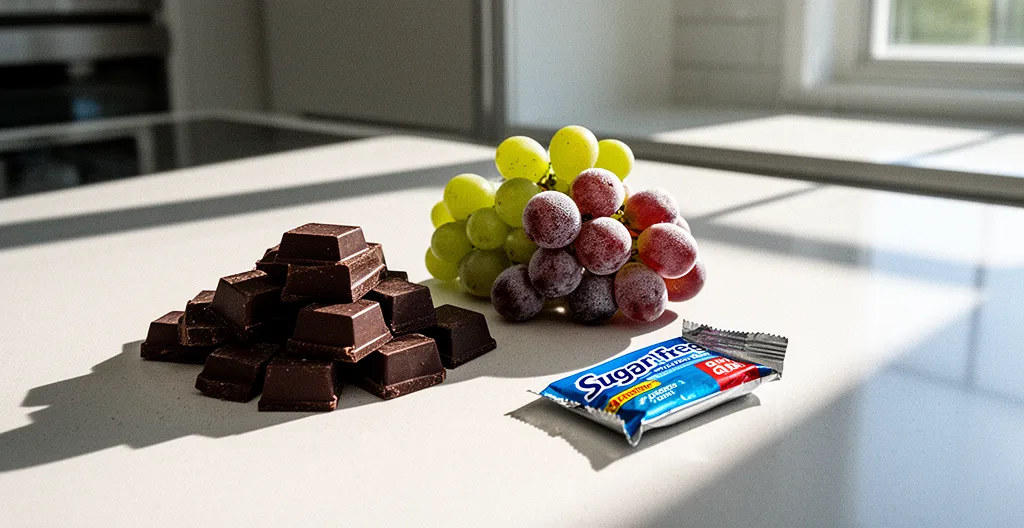
The most lethal threats to your dog are not the obvious scraps but the hidden ingredients like xylitol in “sugar-free” products and the unpredictable nature of common foods like grapes.
- Toxicity is dose-dependent; knowing the type of toxin and amount ingested is critical for a veterinarian.
- Immediate veterinary contact is non-negotiable for certain ingestions, as early intervention is the only factor determining survival in cases of organ failure.
Recommendation: Program the Pet Poison Helpline (888-426-4435) and your vet’s emergency number into your phone immediately. This is not a suggestion; it is your primary line of defense.
As a pet poison helpline operator, I can tell you that the most frantic calls don’t start with “My dog ate chocolate.” They start with “I don’t know what happened.” A dog is seizing, lethargic, or collapsing, and the owner is in a panic, racing against a clock they can’t see. The cause is almost always something unexpected, something they didn’t even register as a threat. It’s the dropped purse containing sugar-free gum, the toddler sharing a handful of raisins, or the well-intentioned guest offering a fatty table scrap.
Most pet owners know the basics: no chocolate, no onions. But this surface-level awareness creates a dangerous blind spot. The true lethality in a modern family kitchen isn’t in the foods you actively avoid, but in the ones you unknowingly welcome. These are the hidden agents, the chemical compounds masquerading as “healthy alternatives” for humans, and the seemingly benign fruits with wildly unpredictable toxicity levels. Relying on generic lists is insufficient and can be fatal.
The critical shift in mindset is to stop thinking like a pet owner and start thinking like a toxicologist. The real question is not *what* is dangerous, but *where* is the danger hidden in your daily routine and what is the exact, life-saving protocol when exposure occurs? This is not just another guide; it is an emergency briefing. It will equip you to identify these specific threats, understand their mechanisms, and execute a first-response protocol with the precision required to save a life.
This article provides an urgent, scenario-based walkthrough of the most critical hidden toxins in your home. We will move from identifying specific ingredients and calculating danger zones to executing the correct emergency procedures, giving you the authoritative knowledge needed to protect your pet effectively.
Summary: A Pet Poison Expert’s Guide to Kitchen Dangers
- Why Checking “Sugar-Free” Gum Labels Can Save Your Dog’s Liver?
- One Grape or a Bunch: How Much Does It Take to Cause Failure?
- Milk vs. Dark Chocolate: Calculating the Theobromine Danger Zone
- The “No Scraps” Rule: How to Explain It to Grandma Without Offense?
- When to Induce Vomiting: The Hydrogen Peroxide Protocol
- Collar vs. Chewable: Which Is Safer for Families With Kids?
- The 3 Red Flags of Pet Food Brands With Frequent Recalls
- How to Recognize the Early Signs of Acute Organ Failure in Dogs?
Why Checking “Sugar-Free” Gum Labels Can Save Your Dog’s Liver?
The term “sugar-free” on a product label should be treated as a red flag, not a sign of safety. The most common sugar substitute, xylitol, is a life-threatening poison to dogs. While harmless to humans, in dogs, it triggers a massive, rapid release of insulin, leading to profound hypoglycemia (a dangerous drop in blood sugar) within 30-60 minutes. This can quickly progress to seizures, collapse, and, in more severe cases, acute liver failure. The danger lies in its prevalence; it’s not just in gum but also in peanut butter, baked goods, chewable vitamins, and even some dental products.
The toxicity is alarmingly high and dose-dependent. According to veterinary toxicologists, dogs ingesting over 0.1 grams of xylitol per kilogram of body weight are at risk for hypoglycemia. Ingesting over 0.5 g/kg can lead to massive liver necrosis—the literal death of liver tissue. A single piece of sugar-free gum can contain anywhere from 0.2 to 1.0 grams of xylitol, meaning just one or two pieces can be fatal for a small dog. Unlike other toxins, there is no “wait and see” approach with xylitol; it is a time-critical emergency from the moment of ingestion.
It is crucial to understand that not all sugar alcohols are equally dangerous. Erythritol and sorbitol, for example, do not cause the same catastrophic insulin release and typically only lead to mild gastrointestinal upset in large quantities. This distinction is why reading the full ingredient list is a non-negotiable safety step.
| Sugar Alcohol | Toxicity Level | Effects on Dogs | Found In |
|---|---|---|---|
| Xylitol | Extremely Toxic | Rapid insulin release, liver failure | Sugar-free gum, candies, peanut butter |
| Erythritol | Generally Safe | May cause mild GI upset in large amounts | Low-carb foods, protein bars |
| Sorbitol | Low Toxicity | Diarrhea if consumed in excess | Diet foods, sugar-free syrups |
| Maltitol | Low Toxicity | GI upset possible | Sugar-free chocolates, baked goods |
One Grape or a Bunch: How Much Does It Take to Cause Failure?
The answer is brutally simple: we don’t know, and you cannot risk finding out. Any ingestion of grapes or raisins (which are simply dried grapes) must be treated as a potential emergency. For years, the toxic agent was a mystery, leading to conflicting information. We now have a definitive answer. An investigation has confirmed that tartaric acid is the culprit, the same compound found in cream of tartar and tamarinds. A breakthrough study showed that kidney damage in dogs after cream of tartar exposure produced lesions identical to those from grape toxicosis.
This discovery explains why toxicity is so unpredictable. The concentration of tartaric acid varies dramatically depending on the type of grape, its ripeness, and where it was grown. This is why one dog might eat a few grapes with no issue, while another could suffer acute, irreversible kidney failure from a single grape. There is no established toxic dose. The only safe number is zero. Because of this variability, owners cannot assess the risk at home. It is a game of Russian roulette you are guaranteed to lose.
This visual metaphor below is critical to understanding the threat. A seemingly innocent fruit casts a shadow of organ damage. This is not an exaggeration; it is the clinical reality veterinarians face.
The signs of grape toxicosis begin with vomiting and lethargy within 24 hours of ingestion. This quickly progresses to signs of kidney failure, including excessive thirst, decreased or absent urination, and abdominal pain. If you suspect your dog has ingested even one grape or raisin, you must contact your veterinarian or a poison control center immediately. This is not a situation for home monitoring. The window for effective decontamination (inducing vomiting and administering activated charcoal) is extremely short, and early, aggressive fluid therapy is the only way to try and protect the kidneys.
Milk vs. Dark Chocolate: Calculating the Theobromine Danger Zone
Not all chocolate is created equal, and the difference can be life or death. The toxicity of chocolate is determined by its concentration of theobromine, a bitter alkaloid of the cacao plant. Dogs metabolize theobromine far more slowly than humans, allowing it to build up to toxic levels that overstimulate the cardiovascular and nervous systems. The rule is simple: the darker and more bitter the chocolate, the more dangerous it is. White chocolate contains negligible amounts of theobromine, while baking chocolate and cocoa powder are the most concentrated and therefore the most lethal.
To assess the danger, you need three pieces of information: the type of chocolate, the amount ingested (in ounces or grams), and your dog’s weight. Mild signs of toxicity (vomiting, diarrhea) can occur at doses as low as 20 mg/kg of theobromine, while severe signs like cardiac arrhythmias and seizures can occur at 40-50 mg/kg. As documented by ASPCA Poison Control, baking chocolate contains 130-450 mg of theobromine per ounce, whereas milk chocolate contains a much lower 44-58 mg per ounce. For a 20-pound dog, consuming just one ounce of baking chocolate can trigger severe toxicity, while it would take nearly a pound of milk chocolate to cause the same effect.
This calculation is not for academic purposes; it is the first thing a poison control expert will ask you. Having this information ready is critical for immediate and accurate triage. If your dog ingests chocolate, your first action is to gather these facts and call for help. Do not wait for symptoms to appear.
Your emergency plan for chocolate ingestion
- Identify the Toxin: Immediately secure the packaging to confirm the exact type of chocolate (e.g., baker’s, semi-sweet, dark, milk).
- Estimate the Dose: Determine the maximum possible amount your dog could have eaten. Be honest and overestimate if unsure. Note the package size (ounces/grams).
- Record Patient Vitals: Know your dog’s current, accurate weight in pounds or kilograms. This is essential for the toxicity calculation.
- Contact Professionals: Call your veterinarian or the Pet Poison Helpline immediately with the information you’ve gathered. Do not use the internet to decide if the dose is “safe.”
- Follow Direct Orders: Do NOT induce vomiting unless explicitly instructed to do so by a veterinary professional. For some conditions or toxins, this can make the situation worse.
The “No Scraps” Rule: How to Explain It to Grandma Without Offense?
One of the most common and difficult scenarios in a family home is managing well-meaning guests and family members, particularly older relatives, who show love through food. Explaining why your dog cannot have a piece of turkey skin or a lick of gravy can feel like you are rejecting their affection. However, this conversation is as crucial to your dog’s safety as locking up medications. Fatty foods can trigger pancreatitis, a painful and potentially fatal inflammation of the pancreas, while many common ingredients (onions, garlic, seasonings) are directly toxic. As a study on household dangers in PubMed notes, “Educating owners about foods and food additives that are unsafe for dogs and cats can help prevent toxicosis.” This education must extend to everyone in your home and all who visit.
The key to this conversation is to be firm but compassionate, shifting the focus from “don’t do that” to “here’s how you can help.” It is not about rules; it is about protecting a beloved family member. Prepare for these interactions in advance by having a clear policy and a simple, consistent message. The goal is to redirect their generosity towards safe interactions.
Educating owners about foods and food additives that are unsafe for dogs and cats can help prevent toxicosis
– Published study authors, PubMed – Hidden dangers in the kitchen
Having a “safe alternative” ready is the most effective strategy. Keep a jar of dog-appropriate treats in a visible location and explicitly invite guests to give those instead. This provides a positive “yes” instead of a confrontational “no.” For persistent situations, do not be afraid to be direct. A calm “Please don’t feed the dog. Her stomach is extremely sensitive, and human food could land her in the emergency room” is a clear and fair boundary. Your priority is the animal’s well-being, not avoiding a moment of social awkwardness. The following scripts can help you navigate this delicate but necessary conversation:
- The Opener: “Grandma, we appreciate so much how much you love [Dog’s Name]. To help us keep her safe, we need your help with one important rule.”
- The Explanation: “Her digestive system is very different from ours, and some foods that are perfectly fine for us can make her seriously ill. We’re trying to be incredibly careful.”
- The Redirect: “I’ve set out her special treats right here. She would absolutely love it if you gave her one of these instead!”
- The Gratitude: “Thank you so much for understanding. It means the world to us that you care about her health.”
When to Induce Vomiting: The Hydrogen Peroxide Protocol
In a moment of panic after your dog ingests a potential toxin, the first instinct is often to make them throw it up. This can be a catastrophic mistake. Inducing vomiting (emesis) is a specific medical procedure, not a universal first-aid step. The decision of whether, when, and how to induce vomiting belongs exclusively to a veterinary professional. As a strict rule, veterinary professionals consistently emphasize that 100% of vomiting induction should be done under their guidance. An incorrect decision can cause more harm than the toxin itself.
The only substance that should ever be considered for at-home induction is 3% hydrogen peroxide—and only under the direct instruction of a veterinarian or poison control expert. They will provide the exact dosage based on your dog’s weight (typically 1 teaspoon per 5-10 pounds of body weight) and guide you through the process. Using anything else, such as salt, syrup of ipecac, or manual stimulation, is dangerous, ineffective, and can lead to secondary complications like salt poisoning or aspiration pneumonia.
More importantly, there are critical situations where inducing vomiting is absolutely contraindicated. Causing a dog to vomit up a corrosive substance like a cleaning agent or battery acid will re-burn the esophagus, throat, and mouth on the way up, doubling the damage. If a dog has ingested a sharp object, the muscle contractions of vomiting can cause a perforation of the stomach or esophagus. Furthermore, if a dog is already showing neurological signs, is unconscious, or has difficulty breathing, inducing vomiting will almost certainly lead to aspiration, causing the vomitus to enter the lungs. This is often fatal. The time window is also a factor; if more than two hours have passed, the toxin has likely already left the stomach, making vomiting useless.
Critical Safety: When You Must NOT Induce Vomiting
- NEVER induce if the dog ingested caustic substances like bleach, drain cleaners, or batteries.
- DO NOT induce if petroleum products like gasoline or motor oil were consumed.
- AVOID if sharp objects (bones, metal, plastic shards) were swallowed.
- STOP if the dog is already showing neurological signs like seizures, disorientation, or is acting abnormally sleepy.
- NEVER attempt if the dog is unconscious, having trouble breathing, or cannot stand.
Collar vs. Chewable: Which Is Safer for Families With Kids?
While not a food item, flea and tick preventatives are powerful insecticides stored in and around the kitchen, posing a significant risk, especially in households with small children. The choice between a medicated collar, a topical liquid, or an oral chewable is not just about efficacy; it’s a critical safety decision for the entire family. The primary risk factor is the transfer of pesticide residue from the pet to children, furniture, and other surfaces.
Flea collars and topical “spot-on” treatments work by coating the dog’s skin and fur with chemicals. While effective, this creates an external residue that can persist for days or weeks. A child petting the dog, or a dog rubbing against a sofa, can transfer these chemicals. This is a particularly high risk for toddlers who frequently put their hands in their mouths. Oral chewables, by contrast, work systemically. The medication is contained within the dog’s body, eliminating the risk of external residue and cross-contamination in the home environment.
For families with young children, the safety profile of oral chewables is demonstrably superior. The only point of contact with the chemical is the brief moment of administration, and the packaging can be disposed of immediately and safely. This minimizes the chance of accidental exposure to children and other pets in the household.
| Treatment Type | Child Safety Risk | Other Pet Risk | Kitchen Contamination Risk |
|---|---|---|---|
| Flea Collars | High – direct contact with pesticide residue | Moderate – grooming transfers chemicals | Moderate – residue on surfaces |
| Oral Chewables | Low – no external residue | Low – contained internally | Low – packaging disposal only |
| Topical Spots | High for 24-48 hours post-application | High – wet application transfers | High – can contaminate furniture |
Key Takeaways
- Always check the ingredient list on “sugar-free” products for xylitol, a highly toxic substance for dogs.
- Any ingestion of grapes or raisins, regardless of the amount, must be treated as an immediate veterinary emergency due to unpredictable toxicity.
- Never induce vomiting without explicit direction from a veterinarian or poison control expert, as it can be fatal in certain situations.
The 3 Red Flags of Pet Food Brands With Frequent Recalls
The most insidious toxins are those given to your dog every single day in their food bowl. While most commercial pet foods are safe, a history of recalls, poor quality control, and non-transparent sourcing can be major red flags. A brand’s track record is a direct indicator of its safety protocols. Pet food recalls are most often issued for two reasons: contamination with pathogenic bacteria like Salmonella or Listeria, or the presence of aflatoxins, which are toxic molds that can grow on corn and grains and cause severe liver damage.
Your responsibility as a pet owner is to be a vigilant consumer. Do not rely on marketing claims on the front of the bag. Instead, turn the bag over and scrutinize the ingredient list and the manufacturer’s information. Vague terms are a significant red flag. An ingredient list that says “meat by-products” instead of “chicken meal” or “beef” lacks transparency. It allows the manufacturer to change sources based on cost, which can lead to inconsistent quality and a higher risk of contamination.
Furthermore, a brand’s history is public information. The FDA maintains a database of pet food recalls. A brand that has had multiple recalls, especially for the same issue, demonstrates a systemic failure in its quality control process. You should also investigate whether the company owns its own manufacturing plants or outsources production, as the latter can sometimes lead to less oversight. A trustworthy brand will be transparent about where its ingredients are sourced and where its food is made.
Pet Food Safety Red Flag Checklist
- Vague Ingredients: Look for generic terms like “meat and bone meal” or “animal fat” without a specified source (e.g., “chicken fat”).
- Recall History: Actively search the brand’s name on the FDA’s pet food recall database. Multiple recalls are a serious warning.
- Lack of Transparency: Be wary of brands that do not disclose their ingredient sourcing countries or manufacturing locations on their website or upon request.
- No Third-Party Testing: Reputable brands often conduct and publish results from third-party labs to verify their food is free from contaminants.
- FDA Warning Letters: Check the FDA database to see if the manufacturer has received official warning letters regarding their facilities or products.
How to Recognize the Early Signs of Acute Organ Failure in Dogs
When a dog ingests a serious toxin, you are in a race against time. The single most important factor for survival is how quickly you recognize the early warning signs and seek veterinary care. Organ failure does not happen instantly; it is a cascade of cellular damage that produces subtle but distinct clinical signs. Knowing what to look for can mean the difference between successful intervention and irreversible tragedy. The progression of xylitol toxicity is a stark example: in documented cases, hypoglycemia can develop within 1-2 hours of ingestion, with liver damage starting within 12 hours.
The early signs are often non-specific and can be easily dismissed as the dog just having an “off day.” This is a fatal mistake. Signs like vomiting, lethargy, and loss of appetite are your first alert. Depending on the organ affected, these will progress to more specific and severe symptoms. One critical but often missed sign of severe abdominal pain (associated with liver failure or pancreatitis) is the “prayer position,” where the dog keeps its front legs on the floor and its rear end in the air. This is an attempt to relieve pressure on a painful abdomen and is a sign of a critical emergency.
Distinguishing between the signs of kidney failure (often from grapes, jerky treats, or certain flowers like lilies) and liver failure (often from xylitol, aflatoxins, or some mushrooms) is crucial for veterinary diagnosis. While you are not expected to diagnose the problem, observing these specific signs can provide your vet with vital clues.
Case Study: The Rapid Progression of Xylitol Toxicity
In documented clinical cases of xylitol ingestion, the timeline of organ failure is terrifyingly fast. Hypoglycemia (low blood sugar), which causes initial signs like weakness and disorientation, develops within 1-2 hours. Vets will see elevated liver enzymes on bloodwork within 12 hours, indicating the start of liver cell death. Coagulopathy—a failure of the blood to clot, leading to internal bleeding—can manifest in less than 24 hours. This demonstrates that there is no time to “wait and see.” Immediate recognition of the first signs is the only path to a potential recovery.
| Organ System | Early Signs (0-12 hours) | Progressive Signs (12-48 hours) | Critical Signs |
|---|---|---|---|
| Kidney Failure | Excessive thirst, frequent urination | Vomiting, lethargy, decreased appetite | No urination, seizures, coma |
| Liver Failure | Vomiting, lethargy, coordination loss | Jaundice (yellow gums/eyes), abdominal pain | Bleeding disorders, seizures, coma |
Your responsibility does not end with reading this guide. Your next step is to physically walk through your kitchen, pantry, and bathroom tonight. Read every label. Move every potential toxin to a secure, high cabinet. Have the difficult conversation with your family members. Program the Pet Poison Helpline and your emergency vet’s number into your phone right now. These actions are the only things that will save your dog’s life when an accident occurs.