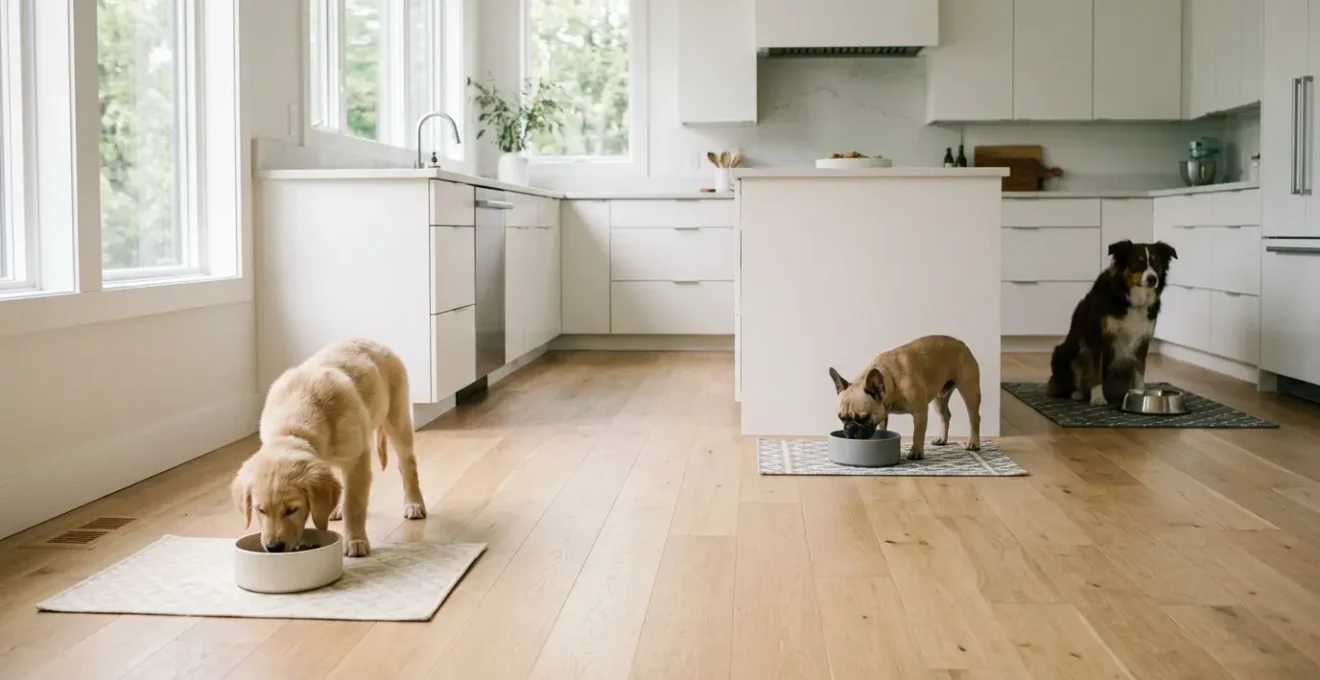
That terrifying growl over a food bowl is not a declaration of war, but a desperate plea for space rooted in deep-seated fear.
- Punishing a growl teaches a dog to bite without warning, removing a critical communication signal.
- True progress comes from teaching your dog that approaching hands and other dogs predict good things, not loss.
Recommendation: Immediately implement strict environmental management (like separate feeding rooms) to stop the behavior from being practiced, then begin slow, positive counter-conditioning to change the underlying emotion.
The sudden, rumbling growl from your otherwise sweet dog when another pet or person approaches their food bowl can stop your heart. In that moment, your home doesn’t feel safe. The immediate reaction for many is fear, confusion, and a feeling of betrayal. You might be tempted by common advice to “show them who’s boss” or punish the growl to assert your leadership. You may have heard it’s a sign of dominance, a battle for rank that you must win.
This is a critical moment, and how you respond will define the future safety of your household. The impulse to correct the behavior is understandable, but it stems from a fundamental misunderstanding of the dog’s motivation. This isn’t a calculated act of defiance or a grab for power. It is a primal, fear-based survival instinct. The dog isn’t being “bad”; it is terrified of losing a valuable resource, and its growl is a desperate attempt to communicate that anxiety.
But what if the key wasn’t to suppress the warning, but to understand it? What if, instead of escalating the conflict, you could de-escalate it by changing your dog’s entire emotional response to the situation? The path to a peaceful multi-dog home is not paved with dominance and punishment, but with safety protocols, trust-building exercises, and a deep understanding of canine communication.
This guide will walk you through this safer, more effective approach. We will decode the “why” behind this instinct, provide a clear, positive method for teaching your dog to willingly share, explain the dangers of common but flawed advice, and give you the tools to create a predictable, low-conflict environment where every member of your household—human and canine—can feel secure.
Summary: A Guide to Resolving Resource Guarding Safely
- Why Guarding Food Is a Natural Survival Instinct, Not Spite?
- The “Drop It” Exchange: Teaching Your Dog That Hands Add Value
- Why Scolding a Growl Creates a Dog That Bites Without Warning?
- Cocker Spaniel Rage or Guarding: How to Tell the Difference?
- The “Safe Zone”: How Far Away Should You Stand While They Eat?
- When to Intervene: The “Freeze” Signal Most Owners Miss
- Why “Flooding” a Fearful Dog Violates Ethical Standards?
- Why “Sometimes” Is the Hardest Rule for Dogs to Understand?
Why Guarding Food Is a Natural Survival Instinct, Not Spite?
Before you can solve resource guarding, you must reframe it. Your dog is not being malicious, dominant, or spiteful. It is acting on a deeply ingrained survival instinct that says, “I need this resource to live, and I am afraid of losing it.” For their wild ancestors, guarding a carcass was a matter of life and death. This software is still running in the background of our well-fed companions, especially in competitive environments like multi-dog homes. The presence of another dog can automatically trigger this ancient fear of scarcity.
This behavior is becoming increasingly relevant as modern households change. In fact, recent industry data reveals that 70% of Gen Z pet owners have two or more pets, creating more opportunities for this competitive instinct to surface. Understanding this behavior starts with observation, not judgment. You need to become a detective of your dog’s body language. What specific items trigger the guarding? Is it just the food bowl, or does it extend to toys, bones, or even a favorite spot on the couch?
Notice the “pressure bubble”—the specific distance at which your dog’s posture changes when another dog or person approaches. They may stiffen their body, lower their head over the item, or give a “hard stare.” These are not acts of aggression but expressions of anxiety. They are the earliest whispers of “I’m uncomfortable, please don’t come closer.” By recognizing these signals as communication driven by fear rather than a challenge for dominance, you shift from being an adversary to being an ally. Your role is not to win a fight but to help your dog feel secure enough that they no longer feel the need to guard.
The “Drop It” Exchange: Teaching Your Dog That Hands Add Value
A common mistake in addressing resource guarding is to demand the dog surrender an item using a confrontational “Leave it!” or “Drop it!” command. This often turns the situation into a battle of wills that you are likely to lose, or worse, that escalates the dog’s fear. A far more effective and safer approach is to reframe the interaction as a positive “trade.” You must teach your dog that the approach of a human hand doesn’t mean the loss of a treasured item, but the gain of something even better. This is the foundation of behavioral economics for dogs.
You start small, far away from any real conflict. The goal is to build a history of positive, voluntary exchanges. This process is about changing the dog’s underlying emotion from “Oh no, they’re coming to take my stuff!” to “Oh good, they’re coming to give me something amazing!” This requires a systematic approach, often called a value hierarchy. You start by trading low-value items for slightly higher-value treats and gradually work your way up.
Here’s a simple progression for building this value hierarchy:
- Level 1: Trade a piece of their regular kibble for a low-value toy they are holding, like a simple rope toy.
- Level 2: Trade a small training treat for a more interesting item, like a tennis ball.
- Level 3: Trade a very high-value treat, like a piece of cheese or chicken, for a high-value item the dog possesses, such as a favorite chew toy or even a “stolen” sock.
- Level 4: Once the trade is reliable, start fading the visible treat. Ask for the “drop,” and when the dog complies, produce the high-value reward from your pocket as if by magic.
This counter-conditioning protocol, when practiced consistently in a controlled and positive manner, teaches the dog that relinquishing items is a rewarding experience. It turns a potential conflict into a cooperative game, building trust and reducing the dog’s need to guard in the first place.
Why Scolding a Growl Creates a Dog That Bites Without Warning?
In a moment of fear and frustration, it’s a natural human impulse to scold a dog for growling. “No!” “Bad dog!” “Stop that!” But this is arguably the most dangerous mistake a pet owner can make. A growl is not the problem; a growl is the dog’s last polite warning before a bite. It is a critical piece of communication on the “canine ladder of aggression.” Before growling, a dog has likely already shown more subtle signs of stress: lip licking, yawning, turning its head away, freezing, or showing the whites of its eyes (whale eye).
When you punish the growl, you do not fix the underlying fear or anxiety. You simply teach the dog that its warning signals are unacceptable to you. The dog learns that growling results in punishment, so it stops growling. However, the fear of losing its resource remains. The next time it feels threatened, it will skip the audible warning it was punished for and may go straight to a snap or a bite. You have successfully created a “silent biter”—a dog that attacks without any perceptible warning. This is a far more dangerous and unpredictable animal.
As one veterinary expert succinctly puts it, this approach is fundamentally flawed because it ignores the dog’s emotional state.
Dogs that are punished for guarding may stop giving the warning signs, but they still don’t want you to take their stuff.
– Dr. Rachel, DVM, Academy for Dog Trainers Veterinary Talk
The correct response to a growl is to de-escalate. Calmly create space by calling the other dog or person away. Do not make a grab for the item. Thank your dog (mentally) for the warning, and make a note of the trigger. Your goal is to respect the communication while managing the environment to prevent it from happening again. By listening to the growl, you keep the lines of communication open and your household safer.
Cocker Spaniel Rage or Guarding: How to Tell the Difference?
In some cases, especially with certain breeds like Cocker Spaniels, owners may worry that a sudden aggressive outburst is a sign of something more severe than typical resource guarding, such as “Rage Syndrome” (Sudden Onset Aggression). While extremely rare, this neurological condition is characterized by explosive, unprovoked attacks. However, in the vast majority of cases, the behavior is resource guarding. Distinguishing between the two is critical for a correct diagnosis and appropriate action plan. The key difference lies in the trigger and the dog’s awareness.
Resource guarding, even if it seems sudden to us, is always triggered by the presence or approach to a specific resource. There is a clear, progressive series of warning signals (stare, freeze, growl) and the dog is fully aware and purposeful in its actions. Rage Syndrome, on the other hand, is completely unprovoked. The dog may be resting or in a calm state and suddenly attack without warning. Afterwards, the dog often appears confused or “absent,” as if it doesn’t remember what happened.
To help you and your veterinary behaviorist make an accurate diagnosis, it’s essential to become a meticulous data collector. This is not a diagnosis you should ever make on your own. A professional assessment is mandatory. The following table, based on guidance from veterinary professionals, highlights the key differences.
| Characteristic | Rage Syndrome | Resource Guarding |
|---|---|---|
| Trigger | None – completely unprovoked | Specific resource present (food, toy, location) |
| Warning Signs | No warning – sudden attack | Progressive signals: freeze, stare, growl, snap |
| Dog’s Awareness | Appears ‘absent’ or confused after | Fully aware and purposeful |
| Frequency | Extremely rare neurological condition | Common behavior in many dogs |
| Treatability | Requires medication/may be incurable | Highly responsive to behavior modification |
Action Plan: Documenting Aggressive Incidents for Your Vet
- Record Safely: If you can do so without risk, video record incidents. Capture the entire sequence from before the trigger to the dog’s recovery phase.
- Log Details: Keep a detailed incident log. Note the date, time, location, all people and animals present, and the specific resource or trigger involved.
- Note Pre-Incident Behavior: What was the dog doing immediately before the incident? Was it sleeping, eating, playing, or being petted?
- Document Post-Incident Behavior: How does the dog act immediately after? Does it seem confused, dazed, continue guarding, or quickly return to a normal, relaxed state?
- Consult a Professional: Present all your video evidence and logs to a board-certified veterinary behaviorist for a professional assessment. Do not attempt to self-diagnose.
The “Safe Zone”: How Far Away Should You Stand While They Eat?
While you work on long-term behavior modification, your immediate priority must be management. Management means changing the environment to prevent the unwanted behavior from being practiced. In resource guarding, this is the most critical and non-negotiable step. The single most effective management tool is creating a completely separate and secure safe zone for feeding and high-value chews. The question isn’t how far away you should stand; it’s how you can guarantee zero interaction.
This means feeding dogs in entirely separate rooms with a closed door between them. Baby gates, crates in different areas, or even tethering dogs on opposite sides of a room are other options. The goal is to remove any perceived threat so the guarding dog can eat in peace. When a dog eats without feeling the need to guard, it is not practicing the problematic behavior, and the neural pathways for that reaction begin to weaken. Conversely, every time the dog feels threatened and successfully guards its food, the behavior is reinforced and becomes stronger.
This isn’t a temporary fix; for many multi-dog households, it’s a permanent safety solution. It may feel inconvenient, but it is a small price to pay for peace and the prevention of a bite. A 2024 protocol from the East Bay SPCA emphasized that this approach is paramount for safety. Their studies on managed multi-dog households showed that a strict separation protocol during feeding resulted in zero conflicts. They stress that even dogs who seem to get along should not be fed in the same space, as the risk of a sudden conflict is always present.
By providing a predictable and conflict-free mealtime, you lower your dog’s overall stress (cortisol) levels. This makes them more receptive to the training and counter-conditioning exercises you will practice at other times. Management is not giving up; it is the essential foundation upon which all successful behavior modification is built.
When to Intervene: The “Freeze” Signal Most Owners Miss
The key to preventing a growl, a snap, or a bite is to intervene long before the dog feels the need to escalate. Most owners miss the most important and earliest warning signal of all: the freeze. A dog that is enjoying a chew or eating from its bowl will have a relaxed body posture. When a potential threat appears, the very first thing that happens is a sudden cessation of movement. The dog will freeze, often for just a split second. The chewing stops, the tail-wagging stops, and the body becomes stiff and tense.
This “freeze” is the moment the dog’s brain is processing a potential threat and deciding what to do next. It is your golden opportunity to intervene and de-escalate. If you can learn to spot this subtle signal, you can prevent 80% of conflicts before they even begin. The freeze is often accompanied by other quiet signals on the communication ladder, such as a sudden closed mouth, a hard stare directed at the approaching individual, a slight forward shift in weight over the resource, or the appearance of “whale eye” as the dog tries to track the threat without moving its head.
When you see the freeze, your intervention should be non-confrontational and designed to interrupt the pattern. Do not yell or rush in. Instead, use a cheerful, upbeat tone to redirect the dogs’ attention. Tossing a handful of high-value treats away from the conflict zone can effectively move both dogs apart. A happy “Who wants to go outside?” or using a well-trained recall cue can also break the tension. This approach, documented by Journey Dog Training, is called a “pattern interrupt” and has been shown to be highly effective at redirecting focus before tension can build into outright aggression.
Learning to see the freeze is like learning a new language. At first, it’s difficult to spot, but with practice, it becomes impossible to miss. By intervening at this earliest stage, you are not only preventing a fight, but you are also teaching your dog that you are an observant and trustworthy ally who helps them avoid uncomfortable situations.
Why “Flooding” a Fearful Dog Violates Ethical Standards?
In a desperate attempt to “fix” the problem, some owners might be tempted by outdated advice that involves “flooding.” Flooding is the practice of forcing a dog to endure a scary situation until it “gets over it”—for example, repeatedly taking a bone from a guarding dog or forcing dogs to eat side-by-side. This approach is not only ineffective but is also considered inhumane and a violation of modern ethical training standards. It is the psychological equivalent of throwing someone with a fear of spiders into a pit of them.
Flooding does not teach the dog to feel safe; it teaches the dog that its environment is unpredictable and that its humans will not protect it from things that terrify it. This can lead to a state of “learned helplessness,” where the dog shuts down and stops responding, which can be mistaken for calmness. More often, it dramatically increases the dog’s anxiety and can make the aggressive response far more intense and violent in the future. It shatters the trust between a dog and its owner, which is the very foundation you need to build upon for successful behavior modification.
The consensus among veterinary behaviorists is unequivocal: confrontational methods make guarding worse. Instead, the ethical and effective approach is based on systematic desensitization and counter-conditioning (DSCC). This means gradually exposing the dog to a trigger at a distance where it is aware but not reacting (staying “under threshold”), and pairing that exposure with something wonderful, like high-value treats. As the dog’s emotional response changes from fear to happy anticipation, the distance can be slowly decreased over many sessions. This process respects the dog’s emotional state and builds confidence rather than fear.
Overwhelming scientific evidence supports this approach. In fact, veterinary research confirms that reward-based methods are more effective and humane for managing behavior problems like resource guarding. Choosing positive methods isn’t just about being “nice”; it’s about using a scientifically validated, safer, and more reliable strategy to achieve lasting change.
Key Takeaways
- Resource guarding is a fear-based survival instinct, not a challenge for dominance. Punishing it will only make it more dangerous.
- The safest and most immediate action is management: feed dogs in completely separate rooms with closed doors to prevent the behavior from being practiced.
- Long-term solutions involve changing the dog’s emotional response through positive counter-conditioning, such as teaching a “trade” game where giving up an item is rewarding.
Why “Sometimes” Is the Hardest Rule for Dogs to Understand?
The single greatest obstacle to resolving resource guarding in a multi-dog household is inconsistency. For any management or training protocol to be effective, it must be followed 100% of the time by 100% of the people in the home. Dogs thrive on predictability. Clear, black-and-white rules create a sense of security. When the rules are “sometimes,” it creates confusion, anxiety, and frustration—the very emotions that fuel resource guarding.
Imagine one person in the family always feeds the dogs in separate rooms, but another person occasionally lets them eat together “because they seem fine today.” This is a recipe for disaster. The dog with guarding tendencies is now on high alert, never knowing when it will need to defend its food. This is a psychological principle called “intermittent reinforcement.” When a behavior is rewarded unpredictably (in this case, the dog “gets to keep” its food by guarding it), the behavior becomes much stronger and more resistant to extinction. This is the same principle that makes slot machines so addictive.
As documented by DW Dog Training, inconsistent management is the primary reason guarding behaviors persist. They describe cases where guarding continued for years because of inconsistent rules but was resolved in a matter of weeks once the entire family committed to an unwavering protocol. Creating a clear set of “house rules” that everyone agrees to and enforces is not about being overly strict; it is about providing the psychological safety your dogs need to relax. These rules might include: all meals and high-value chews are only given in separate, closed-off spaces; toys are picked up before mealtimes; and any growl results in immediate, calm separation, not punishment.
Consistency is the cornerstone of trust. When your dog learns that mealtimes are always safe and free from competition, their anxiety will decrease. When they learn that a human hand approaching always means a positive trade, their need to guard will diminish. But this only works if “always” truly means always. For a dog struggling with anxiety, “sometimes” is the cruelest and most confusing rule of all.
By shifting your perspective from control to communication and from punishment to proactive management, you can transform a frightening situation into an opportunity to build a deeper, more trusting relationship with your dogs. The path requires patience and unwavering consistency, but the result is a safer, more peaceful home for everyone.