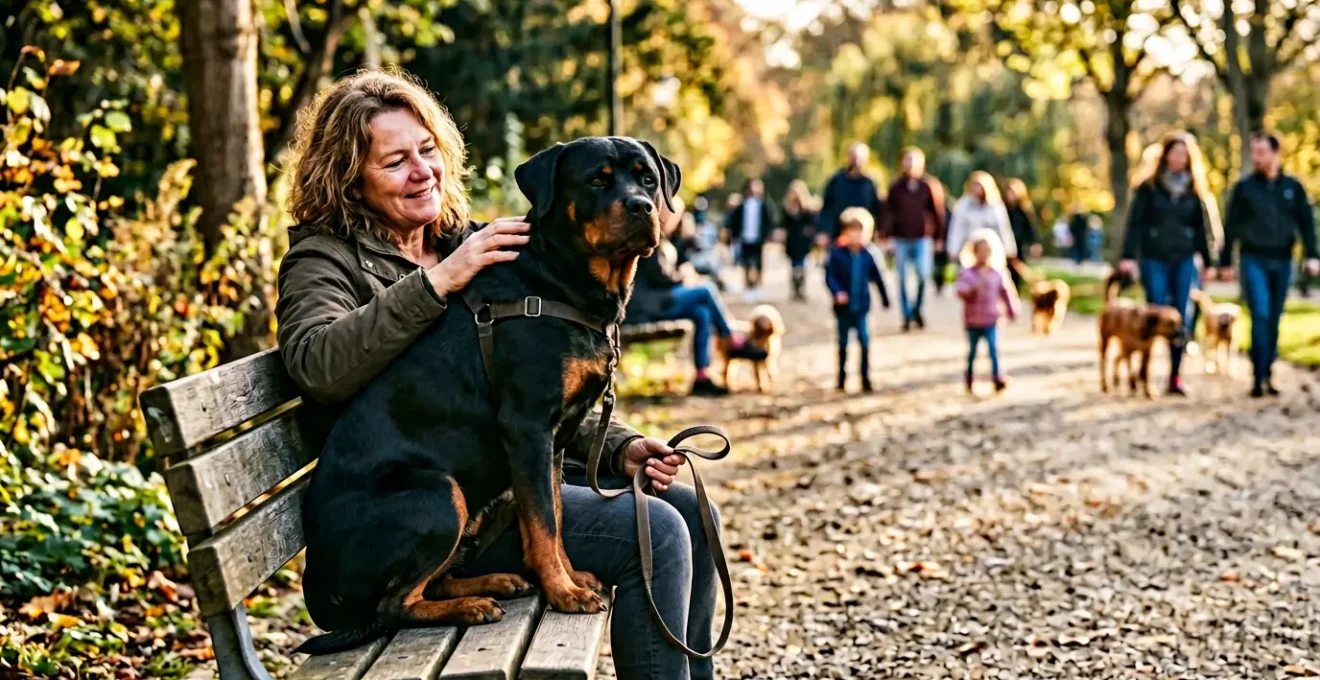
Raising a stable Rottweiler isn’t about physical dominance; it’s about becoming a knowledgeable breed steward who proactively manages their dog’s instincts through structured leadership.
- Outdated “alpha” tactics like force and intimidation create fear and instability, directly contradicting the goal of a confident companion.
- Proactive management of health risks, environmental triggers, and genetic behaviors is the foundation of responsible ownership.
Recommendation: Embrace your role as a breed ambassador by focusing on education, positive reinforcement, and clear communication to build a rock-solid, well-adjusted dog that defies negative stereotypes.
As a Rottweiler owner, you’re not just a pet parent; you’re a steward of a noble and powerful breed. You’ve likely faced the unfair stigma, the wary glances, and the frustrating “dangerous dog” label. The common advice often revolves around having a “firm hand” or establishing yourself as the “alpha,” concepts that are vague and frequently misinterpreted. Many owners believe that brute strength and dominance are the keys to controlling a powerful dog, a misconception that can unfortunately lead to instability and anxiety rather than the calm confidence you seek.
But what if the path to a well-socialized Rottweiler isn’t through force, but through intelligence? What if the true key lies in becoming a breed expert yourself—understanding the ‘why’ behind their behaviors, from their powerful jaw mechanics to their innate guarding instincts? This guide moves beyond the platitudes. It’s a strategic framework for proactive leadership, not reactive dominance. We will dismantle the myths, provide science-backed alternatives to outdated training methods, and equip you with the tools to manage your dog’s health, safety, and behavior with informed confidence.
By embracing this approach, you transform yourself from a mere owner into a true ambassador for the breed. You will learn to cultivate a canine partner who is not only a joy to live with but also a testament to the Rottweiler’s true character: loyal, intelligent, and unshakably stable. This is how we combat breed stigma—one well-raised, well-understood Rottweiler at a time.
This comprehensive guide is structured to walk you through the core pillars of responsible Rottweiler ownership, from understanding their physical nature to mastering their psychological needs. The following sections provide a roadmap to becoming the leader your Rottweiler deserves.
Summary: A Strategic Guide to Rottweiler Stewardship and Socialization
- The Locking Jaw Myth: Understanding Rottweiler Bite Mechanics
- Why “Alpha Rolls” Backfire With Rottweilers and What to Do Instead?
- ACL Tears in Rottweilers: How to Prevent Them During Puppyhood?
- How to Find Home Insurance That Doesn’t Blacklist Your Breed?
- Teaching the “Watch” Command: Controlled Guardianship vs. Barking
- Why Guarding Food Is a Natural Survival Instinct, Not Spite?
- Play Bow or Warning: How to Tell the Difference in 3 Seconds?
- How to Manage Resource Guarding in Multi-Dog Households Safely?
The Locking Jaw Myth: Understanding Rottweiler Bite Mechanics
One of the most persistent and damaging myths about the Rottweiler is the idea of a “locking jaw.” This anatomical fiction must be the first thing a breed steward dispels. A Rottweiler’s jaw is physiologically identical in function to any other dog’s; there is no special mechanism that allows it to lock. The breed’s reputation for a powerful hold stems not from a physical anomaly, but from its sheer determination, strength, and well-developed jaw musculature. Understanding this fact is crucial—it moves the conversation from fantasy to a reality based on manageable traits like bite inhibition and training.
The power of a Rottweiler’s bite is indeed significant, but it must be quantified accurately to be understood. Flawed or misread studies have led to wildly exaggerated figures. A frequently cited study that measured a Rottweiler, a German Shepherd, and an American Pit Bull Terrier provides a much clearer picture. It confirmed that while the Rottweiler had the strongest bite of the group, it was not an otherworldly force. In fact, research confirms the Rottweiler’s bite force measures 328 PSI (pounds per square inch). This is a formidable number, demanding respect and responsible training, but it is a measurable, understandable force—not the stuff of legend.
dramatic lighting > artistic composition.”/>
This anatomical reality underscores the importance of training. Since the power comes from muscle and resolve, a responsible owner’s focus must be on teaching bite inhibition from the earliest age. A well-socialized Rottweiler learns to control the pressure of its mouth, a skill far more critical than any mythical jaw structure. As a breed ambassador, your role is to replace fear-mongering with facts, explaining that a Rottweiler’s reliability comes from superior training, not a non-existent physical quirk.
Why “Alpha Rolls” Backfire With Rottweilers and What to Do Instead?
The outdated concept of the “alpha roll”—physically forcing a dog onto its back in a show of dominance—is particularly dangerous and counterproductive with a Rottweiler. This breed was developed to be a confident, thinking partner. Confrontational methods don’t build respect; they build fear, resentment, and instability. A Rottweiler that is physically dominated is not learning to follow a leader; it is learning that its handler is unpredictable and threatening. This can lead to one of two outcomes: a dog that shuts down and becomes fearful, or a dog that feels it must defend itself, potentially escalating aggression. True leadership is not about force; it’s about calm, consistent, and structured guidance.
Instead of relying on intimidation, a modern Rottweiler owner should implement a “learn to earn” or “Nothing in Life is Free” program. This simple, non-confrontational approach establishes your leadership by making you the gateway to all good things. Before a meal is given, the dog must sit. Before a door is opened for a walk, the dog must wait calmly. This teaches impulse control and reinforces the concept that you are the benevolent leader who provides resources in exchange for polite behavior. It’s a partnership based on mutual respect, not a dictatorship based on fear. This positive reinforcement should begin as soon as you bring your puppy home, ideally between 8 and 10 weeks of age when they are neurologically ready to absorb these lessons.
As a leading Rottweiler training expert, Teresa Bradley, notes in a guide for the American Kennel Club, supervision is key in social settings. She advises:
When meeting other dogs, the owner should always supervise and make sure there is no bullying but appropriate dog-to-dog behavior.
– Teresa Bradley, American Kennel Club – Rottweiler Training Expert
This philosophy of guidance over force is the cornerstone of building a stable temperament. Your confidence and consistency become the foundation your dog trusts, eliminating any perceived need for conflict.
ACL Tears in Rottweilers: How to Prevent Them During Puppyhood?
A crucial part of being a breed steward is proactive health management, and for Rottweilers, this means paying close attention to their orthopedic health. The breed’s powerful build and rapid growth unfortunately put them at a higher risk for certain injuries, particularly rupture of the Anterior Cruciate Ligament (ACL), known as the Cranial Cruciate Ligament (CCL) in dogs. Research from the Royal Veterinary College is stark, showing that Rottweilers have a 3.66 times higher risk of this debilitating injury compared to crossbreeds. This isn’t a matter of chance; it’s a known breed predisposition that responsible owners must actively manage from puppyhood.
Prevention begins with understanding the stressors on a growing puppy’s joints. High-impact activities like jogging on pavement, sharp turns while chasing a ball, or excessive jumping should be strictly limited during their growth phases (up to 18-24 months). These activities place immense torque and pressure on joints and ligaments that are not yet fully developed. Instead, focus on low-impact exercises like swimming (once cleared by a vet) and controlled walks on varied, natural surfaces like grass or sand. These activities build muscle and proprioception—the dog’s awareness of its body in space—which helps to naturally stabilize the knee joint without undue stress.
Perhaps the single most important preventative measure is weight management. Obesity is a major contributing factor to ACL tears in all dog breeds, and this risk is amplified in a heavy-set breed like the Rottweiler. Carrying extra weight places a constant, excessive load on the knee joints, weakening ligaments over time. A lean, well-conditioned Rottweiler is not only healthier overall but is also significantly less likely to suffer this painful and costly injury. Follow your veterinarian’s feeding guidelines meticulously and learn to judge your dog’s body condition by feel, not just by the numbers on a scale.
How to Find Home Insurance That Doesn’t Blacklist Your Breed?
One of the most frustrating realities of Rottweiler ownership is navigating the world of insurance. Many standard homeowner’s and renter’s insurance companies maintain “blacklists” of breeds they deem high-risk, and Rottweilers are almost always on that list. This can make finding coverage a significant challenge. However, being denied by one company does not mean you are uninsurable. It simply means you must be a more prepared and savvy consumer. Your role as a breed ambassador extends to being able to prove, with documentation, that your specific dog is a low-risk, well-behaved citizen.
The key is to build a “Canine Good Citizen Portfolio” for your dog. This is a collection of documents that objectively demonstrates your commitment to responsible ownership and your dog’s stable temperament. This portfolio acts as your evidence when approaching insurance providers, especially independent brokers or specialty insurers who evaluate dogs on a case-by-case basis rather than applying a blanket ban. It transforms the conversation from “I own a Rottweiler” to “I own a certified Canine Good Citizen with a documented history of training and socialization.” This proactive approach is your best defense against breed discrimination.
Your Action Plan: Building the Canine Good Citizen Portfolio
- Obtain Canine Good Citizen (CGC) certification from an AKC-approved evaluator.
- Document all puppy socialization and obedience training classes with certificates of completion.
- Collect letters of recommendation from your veterinarian and a certified professional dog trainer.
- Create a photo and video portfolio showcasing your dog’s calm and appropriate interactions in various settings (e.g., with children, other dogs, in public).
- Keep meticulous records of all training courses, titles, and achievements your dog earns.
When seeking insurance, it’s wise to look beyond captive agents who only represent one company. Independent brokers often have access to a wider market, including surplus line insurers who are more willing to underwrite households with blacklisted breeds. The following table breaks down your primary options.
| Insurance Type | Breed Restrictions | Best For | Documentation Needed |
|---|---|---|---|
| Captive Agents (State Farm, etc.) | Often have breed blacklists | Standard coverage if breed accepted | Basic ownership proof |
| Independent Brokers | Access to surplus line insurers | Case-by-case evaluation | CGC certification, training records |
| Specialty Pet Liability | No breed restrictions | High-risk breeds | Comprehensive documentation portfolio |
Teaching the “Watch” Command: Controlled Guardianship vs. Barking
A Rottweiler’s instinct is to be aware of its surroundings and alert its family to potential changes. A responsible owner doesn’t seek to extinguish this instinct but to channel it into a controlled, useful behavior. Unchecked, this alertness can manifest as incessant, reactive barking. The goal is to teach controlled guardianship. The “Watch” command is the perfect tool for this, training your dog to be a silent, focused sentinel rather than a noisy alarm.
The training process focuses on rewarding the right behavior at the right moment. The key is to mark and reward the initial, silent alert—the pricked ears, the focused gaze—before it escalates into a bark. You give the behavior a name (“Watch”) and reward the quiet focus. Immediately after, you give a release command like “Settle” or “All Clear” and reward the disengagement. This teaches the dog two crucial things: first, that silent alertness is a desirable job, and second, that you are the one who decides when the potential threat is gone and it’s time to stand down. This reinforces your role as the leader who assesses the situation.
atmospheric mood > breed recognition.”/>
Practice should begin in a calm state and in controlled environments. Have a helper walk by at a distance while you practice the “watch” and “settle” sequence. As the dog becomes more reliable, you can gradually decrease the distance and increase the level of distraction. Using high-value treats exclusively for this exercise will reinforce the importance of the task. This transforms a natural instinct from a potential nuisance into a highly sophisticated, cooperative behavior that showcases the breed’s intelligence and trainability, making your dog a far more impressive and effective guardian.
Why Guarding Food Is a Natural Survival Instinct, Not Spite?
When a Rottweiler growls or stiffens as you approach its food bowl, it’s easy to take it personally. Many owners interpret this behavior as a challenge to their authority, a sign of dominance, or simple “spite.” This is a fundamental misunderstanding of canine behavior. Resource guarding, especially around food, is not an emotional or calculated act against you; it is a hardwired survival instinct. In the wild, a canid that couldn’t protect its food would not survive. The growl is not an act of aggression but a form of communication: “This is valuable to my survival, and I feel insecure about losing it.”
Understanding the instinctual root of the behavior is the first step toward resolving it. As the US Service Animals Training Institute explains, this mindset shift is critical for owners. Their guide notes that a dog’s “actions are driven by past associations and survival instincts. This helps the owner move from an emotional reaction (‘He’s doing it to spite me’) to a logical, problem-solving mindset.” Punishing the growl is the worst possible response. It teaches the dog that its warning signals are ignored or punished, which can lead it to skip the warning and go straight to a bite. The growl must be respected as communication, and the underlying insecurity must be addressed through counter-conditioning.
The goal of counter-conditioning is to change the dog’s emotional response to your approach. You want to teach it that your presence near its food bowl predicts something even better, not the loss of its meal. This is done gradually, over many sessions, always staying “sub-threshold”—at a distance where the dog remains calm. You start by simply walking by at a distance and tossing high-value treats (like cooked chicken) toward the bowl. Over time, as the dog begins to look up in happy anticipation of your approach, you can slowly decrease the distance. You are methodically rewriting the dog’s emotional calculus, turning anxiety into positive expectation. This is informed, compassionate management, not a battle of wills.
Play Bow or Warning: How to Tell the Difference in 3 Seconds?
Proper socialization isn’t just about exposure; it’s about ensuring those exposures are positive and safe. As a breed steward, one of your most critical skills is the ability to accurately read dog body language in real-time, especially during play. A Rottweiler’s play style can be physical and intense, and what starts as fun can sometimes escalate. The “play bow”—front end down, back end in the air—is a classic invitation to play, but it’s not an infallible signal. A stiff, tense version can be part of a threat display. You must be able to tell the difference in an instant.
The key is to look at the whole picture, not just one signal. A true play bow is accompanied by a loose, “wiggly” body, a soft, open mouth, and a sweeping, relaxed tail wag. A warning, on the other hand, is characterized by stiffness and tension. The body might be frozen for a split second, the mouth closed, the eyes hard and staring, and the tail held high and vibrating quickly. The vocalizations are also different: a breathy, higher-pitched bark is playful, while a low, rumbling growl signals tension. Learning to assess these clusters of signals allows you to intervene before play escalates into a conflict.
Case Study: Preventing Play Escalation in a Multi-Dog Setting
In a training scenario, a professional trainer observed a Rottweiler puppy named Bex becoming overly dominant during play. When a smaller dog signaled it was uncomfortable, Bex ignored the cues and continued to press. Instead of yelling, the trainer calmly used a short training line to remove Bex from the play session for a five-minute timeout. This simple, non-confrontational consequence immediately connected Bex’s behavior (ignoring signals) with the outcome (loss of play). Bex quickly learned to respect other dogs’ boundaries, demonstrating how calm intervention is far more effective than loud correction in preventing dangerous situations.
This ability to read and act is central to being a responsible owner. It allows you to advocate for your dog, ensuring it learns appropriate social skills and that other dogs feel safe in its presence. Your calm, confident intervention teaches your Rottweiler that you are in control and will ensure all interactions remain positive, further building its trust in your leadership.
Key Takeaways
- Leadership Through Structure, Not Force: True leadership is established by controlling resources and setting clear, consistent boundaries—not through physical intimidation or “alpha” roles.
- Proactive Management is Prevention: A responsible owner understands and manages the breed’s genetic predispositions for health issues (like ACL tears) and behaviors (like guarding) before they become problems.
- You Are a Breed Ambassador: Every public interaction is an opportunity to dismantle negative stereotypes. A well-behaved, stable Rottweiler is the most powerful argument against breed prejudice.
How to Manage Resource Guarding in Multi-Dog Households Safely?
Managing a single dog with resource guarding tendencies requires care; managing it in a multi-dog household requires impeccable, non-negotiable safety protocols. The presence of a second dog exponentially increases the potential for conflict, as competition is no longer theoretical but a living, breathing reality. In this scenario, the owner’s role shifts from trainer to risk manager. The ultimate goal is not necessarily to have dogs happily share everything, but to create an environment where conflicts over resources are impossible.
The cornerstone of multi-dog resource guarding management is separation and structure. High-value resources like food bowls and prized chews should never be given to the dogs in a shared space. Feeding must occur in separate rooms, behind closed doors, or in individual crates. This completely removes the opportunity for conflict. There is no stare-down over a bowl, no tense approach, no chance for a fight to erupt. This isn’t a training failure; it’s a management success. For lower-value items like toys, a strict rotation system and heavily supervised play can work, but all toys should be picked up when supervision ends.
A “stationing” protocol is an invaluable training tool for creating order. This involves teaching each dog to go to a designated spot—a specific mat or bed—and stay there. This skill can then be used to manage excitement and create space before any resources are distributed. For instance, both dogs are sent to their mats before you prepare their meals. They learn that calm, stationary behavior is what makes good things happen. The table below outlines a tiered management approach based on the resource’s value.
| Resource Type | Risk Level | Management Strategy | Training Approach |
|---|---|---|---|
| Food Bowls | High | Separate rooms, visual barriers | Never attempt to share |
| High-Value Chews | High | Individual crates only | Trade exercises separately |
| Regular Toys | Medium | Supervised play, rotation system | Drop it command training |
| Sleeping Spots | Low-Medium | Multiple beds, defined spaces | Go to mat training |
| Owner Attention | Variable | Structured interaction times | Wait and take turns training |
Ultimately, your primary responsibility is the safety of every living being in your home. By implementing strict management protocols, you are not admitting defeat; you are demonstrating the highest level of leadership and responsibility.
By embracing these strategies, you are not just training a dog; you are cultivating a stable, confident canine ambassador. It is through this dedication to informed, proactive ownership that you can truly honor the Rottweiler breed and actively dismantle the undeserved stigma it faces. Your next step is to commit to this path of leadership and begin implementing these principles today.