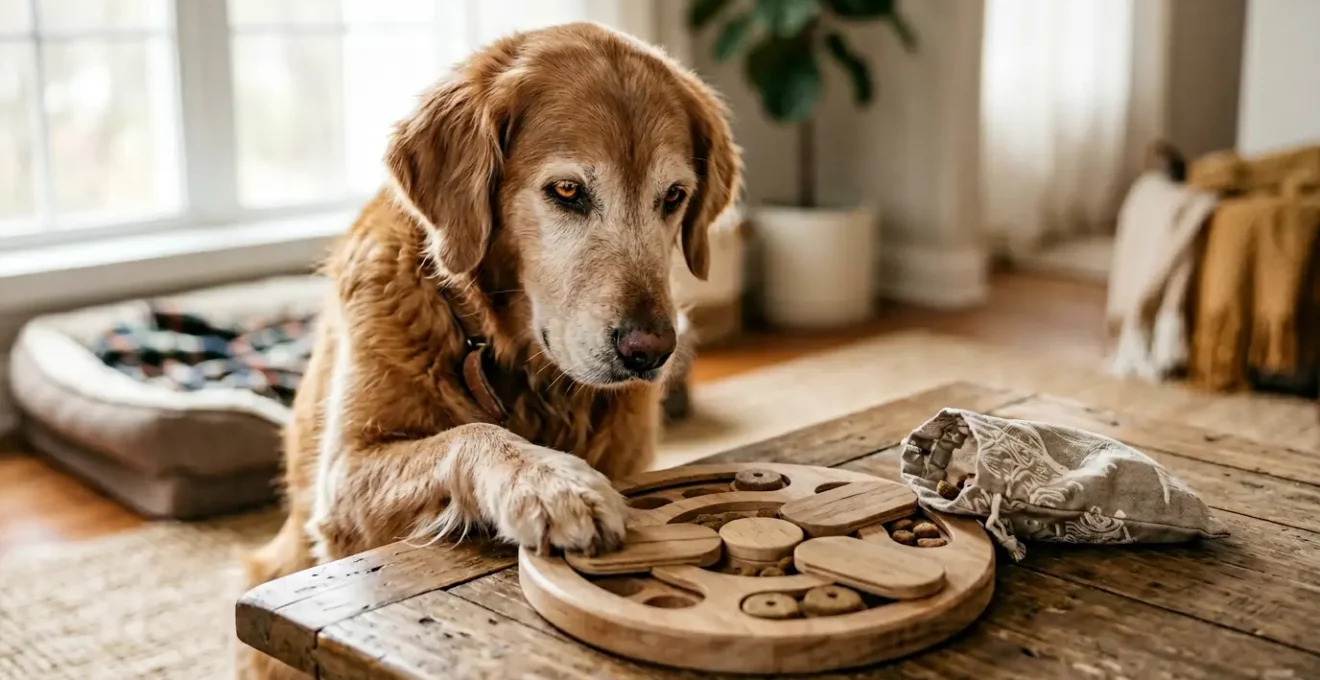
Counterintuitively, a 15-minute brain game session is more effective at tiring your senior dog and delaying cognitive decline than a one-hour walk.
- Mental exercise directly targets neuroplasticity, building new neural pathways that physical activity alone cannot.
- Scent work and shaping exercises create a higher “cognitive load,” which is the key to strengthening an aging brain.
Recommendation: Shift your focus from simply exercising your dog’s body to strategically challenging their brain with targeted problem-solving tasks.
Observing the subtle slowing of a beloved senior dog can be a poignant experience. The once-sharp responses may dull, and you might notice new anxieties or moments of confusion. These are often the first whispers of Canine Cognitive Dysfunction (CCD), a condition akin to Alzheimer’s in humans. While a dog is generally considered senior around 7 to 10 years old, depending on breed size, the focus of modern canine science is no longer on passive acceptance of this decline. The prevailing wisdom often suggests more walks or new toys, but this approach barely scratches the surface of the brain’s profound potential for adaptation.
The canine brain is a universe of approximately 86 billion neurons, a dynamic network that retains the ability to change and form new connections throughout life—a process known as neuroplasticity. The mistake many owners make is underestimating this capacity in their older companions. The true frontier in preserving canine cognitive health lies not in adding more mileage to their paws, but in strategically increasing the cognitive load of their daily activities. This means moving beyond simple physical exertion and engaging the complex systems of the brain responsible for problem-solving, sensory processing, and memory.
This guide will deconstruct the mechanics of cognitive training. We will explore why a short, focused session of “shaping” can be more neurologically taxing than a long walk, how “find it” games directly stimulate the powerful olfactory cortex, and why planned rest days are as critical as the training itself. Forget the platitudes; we are about to delve into a neuro-enrichment protocol designed to build cognitive resilience and keep your senior dog’s mind vibrant and engaged for as long as possible.
This article provides a complete framework for implementing a brain-centric care plan for your aging companion. Explore the sections below to understand the science and master the techniques that will make a real difference.
Table of Contents: A Neuro-Enrichment Protocol for Your Senior Dog
- Why You Can (and Should) Teach an Old Dog New Tricks?
- 15 Minutes of Shaping vs. 1 Hour of Walking: Which Tires the Brain?
- How “Find It” Games Engage the Olfactory Cortex?
- Free Shaping: How to Build Problem-Solving Confidence?
- The Importance of Latent Learning: Why Rest Days Boost Performance?
- The Sniffing Mistake That Frustrates 80% of Leash Walkers
- 3 Mental Games That Tire Out a Shepherd Faster Than a 5k Run
- How to Adjust Your Senior Dog’s Diet to Prevent Kidney Decline?
Why You Can (and Should) Teach an Old Dog New Tricks?
The old adage is not just folklore; it’s a profound misunderstanding of canine neurology. The senior dog’s brain, far from being a static organ, is a testament to the power of neuroplasticity. Every time your dog learns a new behavior, their brain is actively forming and strengthening neural connections. This process is not just a fun party trick; it’s a powerful defense mechanism against the cognitive erosion that defines Canine Cognitive Dysfunction (CCD). The urgency is real, as compelling research from the Dog Aging Project shows a 52% increase in CCD odds with each additional year of age. Proactive cognitive engagement is not an option; it’s a necessity.
Teaching an old dog a new trick is a direct injection of novelty and problem-solving into their routine. It forces the brain to move out of autopilot and forge new pathways. This isn’t about demanding complex agility routines. The goal is simply to introduce a challenge that requires thought. When training a senior, adaptations are key. It’s crucial to work with their physical abilities, not against them. For example, for an arthritic dog, teaching a “nose touch” to a target is far better than a “paw shake,” as it avoids stressing sore joints. Sessions should be short, positive, and built on a foundation of success to keep the dopaminergic pathways firing, associating learning with reward and pleasure.
The key is consistency and simplicity. Use clear, one-word commands and celebrate every small success. Training should always occur on non-slip surfaces to ensure your dog feels secure. By making these small adjustments, you transform a simple training session into a powerful tool for building cognitive reserve, effectively fortifying the brain against the inevitable challenges of aging.
15 Minutes of Shaping vs. 1 Hour of Walking: Which Tires the Brain?
Not all forms of exhaustion are created equal. A one-hour walk primarily taxes the musculoskeletal system, offering sensory exposure but a relatively low cognitive load. In contrast, a 15-minute session of “shaping”—the process of building a new behavior step-by-step—places an intense demand on the brain’s executive functions: focus, problem-solving, and memory. This mental exertion is what truly tires a dog, especially an intelligent one, and it’s precisely what an aging brain needs to stay resilient.
This concept was powerfully demonstrated in research by psychologist Norton W. Milgram at the University of Toronto. His work showed that giving older dogs mental challenges through new problem-solving tasks directly changed their brain physiology, creating new connections between neurons. It’s not just about keeping them “busy”; it’s about targeted neurological activation. Physical exercise is crucial for cardiovascular health, but for cognitive vitality, mental exercise is the more potent tool.
As the visual above illustrates, a shaping session is a focused, collaborative effort. It requires the dog to think, predict, and experiment. This is fundamentally different from the passive experience of a routine walk. The following table breaks down the crucial distinctions for a senior dog.
| Activity Type | Duration | Primary Benefits | Senior Dog Suitability |
|---|---|---|---|
| 1-Hour Walk | 60 minutes | Physical exercise, sensory exposure | May be challenging for dogs with mobility issues |
| Shaping/Brain Games | 15 minutes | Cognitive stimulation, problem-solving, focus | Ideal – requires minimal physical movement |
| Puzzle Toys | 5-15 minutes | Mental engagement, treats as reward | Perfect for floor-level play or lying down |
| Scent Work | 10-20 minutes | Uses strong sense of smell, calming effect | Excellent – minimal physical demand |
How “Find It” Games Engage the Olfactory Cortex?
A dog’s primary sense for interpreting the world is not sight, but smell. Their brain is dominated by the olfactory cortex, a region proportionally 40 times larger than in humans. This is backed by biology; research shows that dogs have up to 300 million odor receptors in their noses, compared to a mere 6 million in humans. When we engage this powerful sense through “find it” games, we are not just playing; we are activating a massive portion of their brain in a way that is deeply natural and satisfying for them.
Scent work is the perfect cognitive exercise for senior dogs, particularly those with mobility issues, as it requires minimal physical movement but immense mental focus. The act of searching, discriminating between scents, and pinpointing a source is a complex problem-solving task. It has the added benefit of being a calming activity, as intense sniffing can lower a dog’s heart rate. This makes it an ideal way to provide enrichment without causing physical stress.
To begin, start simple. Hide a high-value treat in an obvious location in one room and give the cue “Find it!” As your dog succeeds, you can progressively increase the difficulty. Move to hiding treats in multiple rooms, create faint scent trails with crumbs for them to follow, or use different containers that require manipulation to open. The key is to keep sessions short (10-20 minutes) to prevent mental fatigue and always end on a successful find to build confidence. This progressive challenge keeps the brain engaged and continuously adapts to their improving skills.
Free Shaping: How to Build Problem-Solving Confidence?
Free shaping is a more advanced form of cognitive training where the dog is rewarded for offering behaviors voluntarily, without lures or explicit commands. The owner simply “marks” and rewards small actions that move toward a final goal behavior. For an aging brain, this is a powerful exercise in creativity and initiative. It shifts the dog from a passive recipient of commands to an active problem-solver, building a sense of agency and confidence that can counteract the anxiety and helplessness sometimes associated with cognitive decline.
This confidence boost is not just anecdotal. A fascinating study from Vetmeduni Vienna demonstrated that senior dogs respond positively to cognitive training using touchscreen games, a form of digital shaping. The researchers found that once the dogs learned the game, they became avid participants. As lead cognitive biologist Ludwig Huber noted, the mental reward is significant:
The positive feeling created by solving a mental challenge is comparable to the feeling that older people have when they learn something new, doing something they enjoy.
– Ludwig Huber, Vetmeduni Vienna cognitive biologist study
This process of self-discovery activates the brain’s reward system, creating a positive feedback loop where problem-solving becomes inherently reinforcing. It teaches a dog *how* to learn, a meta-skill that is invaluable for maintaining cognitive flexibility.
Your Action Plan for a Successful Shaping Session
- Define the Goal: Start with a simple objective, like getting your dog to touch a specific target with their nose.
- Prepare the Environment: Choose a quiet space with no distractions. Have high-value, small treats and a clicker (or a verbal marker like “Yes!”).
- Start Small: Click and treat any initial interaction with the object—a look, a sniff, a step toward it. Don’t expect the final behavior immediately.
- Raise the Criteria: Once your dog is consistently offering one behavior (e.g., sniffing the target), stop rewarding it and wait for them to offer something more, like a nose touch.
- Keep Sessions Short: Limit sessions to 5 minutes. End on a high note with a successful repetition to build enthusiasm for the next session.
The Importance of Latent Learning: Why Rest Days Boost Performance?
In our drive to provide enrichment, it’s easy to overdo it. We can fall into the trap of thinking that more training always equals better results. However, cognitive science tells us the opposite. The brain needs downtime to process and store new information. This phenomenon, known as latent learning or memory consolidation, is when the neural connections forged during a training session are strengthened and made permanent. This process primarily happens during rest and sleep.
For a senior dog, whose brain is already working harder to function, rest days are not a luxury; they are a critical component of any effective cognitive training program. Pushing them with daily, intense brain games can lead to mental fatigue, frustration, and a decrease in performance. You might observe signs like yawning, looking away, or displacement behaviors like frantic scratching. These are clear signals that the brain is overloaded and needs a break. Providing a “cognitive rest day” with only familiar, low-stress activities like a gentle walk or cuddling allows the brain to sort, file, and cement the previous day’s learning.
Ignoring the need for rest is a common mistake that can undermine your entire effort. The goal is to create a sustainable rhythm of challenge and recovery. A typical schedule might involve one or two days of focused training followed by a day of rest. This approach respects the brain’s natural learning cycle and prevents burnout, ensuring that cognitive enrichment remains a positive and productive experience for your aging companion.
The Sniffing Mistake That Frustrates 80% of Leash Walkers
The daily walk often becomes a source of frustration for owners. We have a destination in mind, a pace to keep, and the dog’s constant desire to stop and sniff every post and blade of grass feels like an interruption. This is the fundamental mistake: viewing the walk as a human-centric “transit” activity rather than a canine-centric “sensory exploration.” For a senior dog, a walk where they are constantly pulled away from sniffing is a walk devoid of its primary mental benefit. Denying them the chance to sniff is like forcing a human to walk through an art gallery blindfolded.
The solution is to reframe the walk by implementing a “Walk-Zoning” strategy. This involves consciously dividing the walk into two distinct types of zones. “Transit Zones” are for focused, heel-walking, used to get from point A to point B, such as crossing a busy street. Here, the focus is on moving together. In contrast, “Sniffari Zones” are designated areas—a park, a quiet field, a particularly interesting patch of grass—where the dog has complete freedom to explore at their own pace. In these zones, you use a longer leash (where safe) and your job is simply to be the anchor while their nose does the work.
This strategy satisfies both owner and dog. It provides predictable structure while allowing for crucial periods of deep mental engagement. Allowing your senior dog just five extra minutes of uninterrupted sniffing in a Sniffari Zone provides more cognitive enrichment than an extra 15 minutes of brisk, non-stop walking. Consistently varying your routes to expose them to new smells further enhances the benefit, turning a mundane daily chore into a powerful, brain-boosting adventure.
Key Takeaways
- Targeted mental exercise (15 min) is neurologically more potent for senior dogs than prolonged physical exercise (60 min).
- Engaging a dog’s sense of smell through scent work is one of the most effective ways to activate a large portion of their brain with minimal physical stress.
- Rest days are not optional; they are critical for memory consolidation, allowing the brain to process and store what it has learned.
3 Mental Games That Tire Out a Shepherd Faster Than a 5k Run
For high-drive, intelligent breeds like German Shepherds, Border Collies, or Poodles, a purely physical exercise regimen is often insufficient, even in their senior years. Their minds crave work. A 5k run may tire their bodies, but their brains can remain under-stimulated and restless. The key is to provide games that demand a high cognitive load, combining memory, focus, and problem-solving. This is powerfully supported by The Dog Aging Project study, which found the odds of CCD were 6.47 times higher in dogs who were not active (physically and mentally) compared to those who were very active.
Here are three high-intensity mental games that can be adapted for a senior dog’s physical abilities and will leave their brain thoroughly exercised:
- The Three Cup Shuffle: This classic game is a pure test of focus and short-term memory. Place a treat under one of three opaque cups while your dog watches. Slowly shuffle the cups around. Then, give the cue to find the treat. As they master it, you can increase the speed or number of shuffles. This forces them to track an object visually, a demanding cognitive task.
- Obstacle Course Memory: You don’t need agility equipment. Create a simple course in your living room using dining chairs to weave through or a broomstick laid on two books to step over. Guide your dog through the course once, then ask them to repeat it from memory. This engages their proprioception (body awareness) and spatial memory.
- Advanced Hide and Seek: This game builds on the “Find It” principle but adds a social component. Have your dog “stay” while you go and hide. Start with easy spots, then progressively choose more difficult locations. When you call them, they must use hearing, scent, and memory of your habits to locate you. The problem-solving and eventual reunion provide a huge dopamine rush.
These games are mentally taxing. A 10-minute session can be more exhausting than a 30-minute fetch session. Always monitor for signs of fatigue and end on a positive note to keep the experience rewarding.
How to Adjust Your Senior Dog’s Diet to Prevent Kidney Decline?
While cognitive training is the primary focus, brain health is intrinsically linked to overall physiological wellness. Nutrition is the fuel that powers the brain, and for a senior dog, dietary adjustments are critical not only for cognitive support but also for protecting aging organs like the kidneys. As dogs age, their kidneys can become less efficient at filtering waste products from the blood. A properly formulated diet can reduce the load on these vital organs and provide the specific nutrients the brain needs to combat oxidative stress.
The cornerstone of a brain-healthy, kidney-friendly senior diet involves several key modifications. First, protein should be of high quality and highly digestible. This provides essential amino acids without creating excessive nitrogenous waste that the kidneys must process. Phosphorus and sodium levels should also be carefully managed to reduce renal strain. Second, incorporating omega-3 fatty acids, particularly EPA and DHA found in fish oil, provides powerful anti-inflammatory benefits that support both brain and joint health. Finally, antioxidants are crucial. As scientific studies have demonstrated, a diet rich in antioxidants helps older dogs combat the cellular damage caused by free radicals and can even improve their ability to learn.
Here are essential dietary modifications to discuss with your veterinarian for your senior dog:
- Provide high-quality, highly digestible protein while managing phosphorus and sodium levels.
- Add omega-3 fatty acids (EPA/DHA) for their anti-inflammatory brain benefits.
- Include foods rich in antioxidants (like vitamins E and C, selenium, and carotenoids) to combat oxidative damage.
- Ensure easy food and water accessibility, perhaps with raised bowls to reduce neck strain.
- Consider adding low-sodium broth or switching to a wet food to increase hydration, which is vital for kidney function.
- Monitor your dog’s weight and body condition closely, as unexplained weight loss can be a sign of underlying issues.
A tailored diet is a non-negotiable pillar of a holistic approach to senior care. It supports the body’s systems, allowing the mind to reap the full benefits of your cognitive enrichment efforts. To apply these principles effectively, the next logical step is to consult with your veterinarian to create a specific dietary plan for your dog’s individual needs.
Frequently Asked Questions About Senior Dog Cognitive Training
How long should brain game sessions last for senior dogs?
Most senior pets do best with short sessions—about 5 to 15 minutes—once or twice a day. Consistency matters more than duration, as shorter, frequent sessions prevent mental fatigue and build confidence.
What are signs that a senior dog needs a cognitive rest day?
Watch for clear signs of mental fatigue such as yawning, looking away from the activity, lying down mid-session, or displacement behaviors like frantic scratching or licking. These indicate the brain is overloaded and needs a break to consolidate learning.
What activities are suitable for cognitive rest days?
Ideal rest day activities have a very low cognitive load. Stick to gentle, familiar walks on a known route, cuddling, simple grooming sessions, or just quiet time in a comfortable bed. The goal is to allow memory consolidation without introducing new information to process.