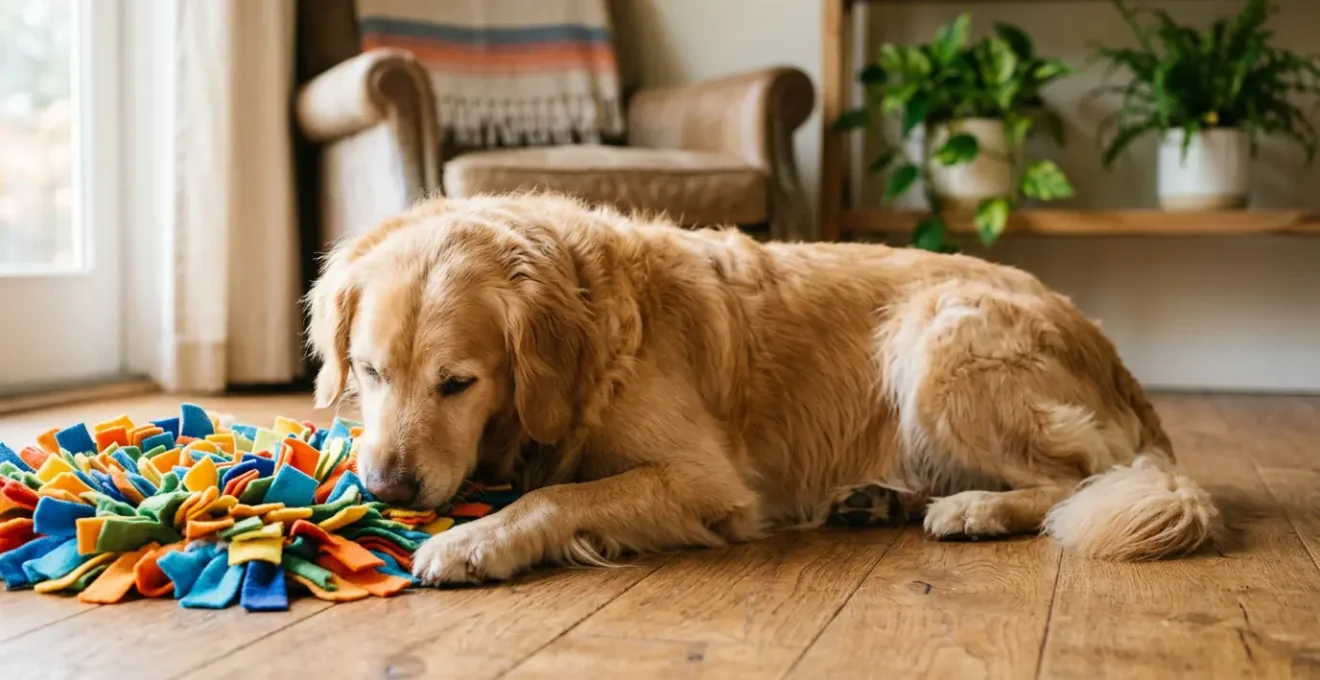
In summary:
- Sniffing for 10-20 minutes provides as much mental enrichment as a full hour of running, actively lowering your dog’s stress hormones like cortisol.
- Using a snuffle mat instead of a bowl taps into a dog’s natural “contrafreeloading” instinct (the desire to work for food), which prevents bloat and reduces anxiety.
- Safety is paramount: always supervise, teach your dog to sniff (forage) not chew (dissect), and choose a machine-washable fabric like fleece.
- For anxious or fearful dogs, a slow introduction is key to building confidence and associating the mat with a positive, calming experience.
The rain is lashing against the windows, the wind is howling, and your dog is a bundle of nervous energy, pacing the apartment floor. You can’t go for your usual long walk, and every chew toy has lost its appeal. This is a familiar scene for many apartment dwellers, where a high-anxiety dog with pent-up energy can turn a cozy day indoors into a stressful one. The common advice—offer a puzzle toy or play a quick game of tug—often feels like a temporary patch, a mere distraction rather than a true solution.
These methods engage your dog, but they don’t always address the root of the anxiety. They skim the surface of canine enrichment. But what if the key to truly calming your dog wasn’t just about keeping them busy, but about tapping into their most powerful biological hardware? What if you could provide an activity that acts as a neurochemical reset button, actively down-regulating their stress from the inside out? This is where the snuffle mat transforms from a simple fleece toy into a sophisticated enrichment tool.
This article moves beyond the basic “how-to” to explore the science of why sniffing is so profoundly calming for a dog. We’ll delve into the neurochemical magic that happens in your dog’s brain, show you how to choose or even make the perfect mat, and provide concrete safety protocols to ensure this activity remains a fun and positive part of your routine. We will also cover how to introduce a mat to a fearful dog and the simple hygiene steps to keep it clean and safe, giving you a complete framework to master this powerful indoor solution.
This guide provides a comprehensive look at how a simple mat can become your greatest ally against indoor anxiety. Explore the sections below to unlock the full potential of scent work for a happier, calmer companion.
Summary: How to Use Snuffle Mats to Calm High-Anxiety Dogs Indoors?
- Why 10 Minutes of Sniffing Equals 1 Hour of Running for Cortisol?
- Fleece vs. Cotton: Which Fabric Holds Treats Better for DIY Mats?
- Bowl vs. Mat: Why Ditching the Bowl Helps Digestion?
- The Supervision Rule: Preventing Your Dog From Eating the Fleece Strips?
- How Often to Wash Your Snuffle Mat to Prevent Acne?
- The Sniffing Mistake That Frustrates 80% of Leash Walkers
- Bowl vs. Mat: Which Feeding Method Encourages Neophobic Dogs?
- How “Find It” Games Engage the Olfactory Cortex?
Why 10 Minutes of Sniffing Equals 1 Hour of Running for Cortisol?
The idea that a quiet sniffing session could be more tiring than a vigorous run seems counterintuitive, but it’s rooted in canine neuroscience. While running primarily taxes the body, sniffing intensely engages the brain. This mental workout is incredibly effective at reducing stress. In fact, canine behavior experts suggest that 20 minutes of quality sniffing provides the same level of enrichment as an hour-long, fast-paced walk. This isn’t just about preventing boredom; it’s a biological process.
When a dog sniffs, they are activating a part of their brain called the “Seeking System.” This primal drive to explore and find resources triggers a cascade of positive neurochemicals. The most important of these is dopamine, the “feel-good” molecule associated with pleasure and reward. This release of dopamine has a powerful anti-anxiety effect, essentially overriding feelings of stress and fear. Simultaneously, this focused activity activates the parasympathetic nervous system, which is responsible for the “rest and digest” state. This lowers the dog’s heart rate, slows their breathing, and reduces levels of the stress hormone, cortisol.
So, when your anxious dog uses a snuffle mat, they aren’t just looking for food. They are engaging in a self-soothing activity that physically changes their brain chemistry from a state of high-arousal anxiety to one of calm, focused foraging. It’s a natural, instinct-driven form of therapy you can provide right on your living room floor.
Fleece vs. Cotton: Which Fabric Holds Treats Better for DIY Mats?
If you’re feeling creative, making your own snuffle mat is a fun and cost-effective project. The most important decision you’ll make is the fabric. The two main contenders are fleece and cotton, but for a truly effective and durable mat, anti-pill fleece is the undisputed winner. Fleece is a synthetic polymer that is soft, stretchy, and incredibly durable. Its texture is perfect for trapping scents, especially from oily or fatty treats, keeping your dog engaged for longer.
The stretchiness of fleece makes it easier to tie tight, secure knots onto the mat base, creating a dense “forest” of fabric for treats to hide in. Cotton, while cheaper, is less durable, doesn’t hold scents as well, and its lack of stretch can make it more difficult to work with. Over time and through multiple washes, cotton will wear out much faster than a high-quality fleece will.
As you can see in the texture detail, the plush, fibrous nature of fleece creates countless nooks and crannies. This not only makes the game more challenging and rewarding for your dog but also provides a soft, inviting surface for them to bury their nose in. For a DIY project, investing in anti-pill fleece from a craft store will result in a longer-lasting, more engaging, and machine-washable tool for your dog’s enrichment.
This comparison, often shared by DIY enthusiasts, clearly shows why fleece is the superior choice for a homemade snuffle mat.
| Feature | Fleece (Anti-pill) | Cotton |
|---|---|---|
| Durability | High-quality anti-pill fleece more durable | Standard cotton less durable |
| Scent Retention | Synthetic polymer holds fatty/oily treat smells longer | Less scent retention |
| Texture Experience | Soft, inviting, but may create static | Neutral texture, less engaging |
| Washing Frequency | Machine washable, withstands frequent washing | Machine washable but may wear faster |
| Price per Yard | $10-15 on sale at craft stores | Generally less expensive |
| Stretchiness | Stretchy horizontally, easier to tie knots | Less stretch, harder to secure |
Bowl vs. Mat: Why Ditching the Bowl Helps Digestion?
For centuries, the food bowl has been the standard. But for many dogs, especially those prone to anxiety or fast eating, the bowl can be a source of problems. Ditching the bowl in favor of a snuffle mat is about more than just enrichment; it has significant psychological and digestive benefits. The core principle at play is a behavior known as “contrafreeloading.” Extensive research on contrafreeloading demonstrates that many animals, including dogs, actively prefer to work for their food rather than eat it from a freely available source. This instinct to work satisfies a deep genetic need to forage and problem-solve.
From a digestive standpoint, the benefits are profound. Fast eaters often gulp down air along with their food, a condition called aerophagia. This is a leading cause of gastric dilatation-volvulus (GDV), or bloat, a life-threatening emergency, particularly in deep-chested breeds. A snuffle mat forces a dog to slow down, eating one piece of kibble at a time. This simple change dramatically reduces air intake and improves digestion.
Beyond the physical, the switch from bowl to mat can transform mealtime from a high-arousal, two-second gulping event into a calm, mindful, 15-minute foraging session. This has several positive behavioral effects:
- Prevents air swallowing (Aerophagia), a primary cause of dangerous bloat.
- Activates natural foraging instincts, fulfilling a core behavioral need that a bowl cannot.
- Transforms high-arousal gulping into a calm, focused mental activity.
- Reduces resource guarding behaviors that can sometimes be triggered by an open bowl.
- Provides essential mental stimulation that turns mealtime into a brain game.
The Supervision Rule: Preventing Your Dog From Eating the Fleece Strips?
A snuffle mat is a tool for enrichment, not a chew toy. The single most important rule of snuffle mat use is: always supervise your dog. No mat is indestructible, and an unsupervised dog may decide that shredding the fleece and swallowing the pieces is more fun than sniffing for kibble. This can lead to choking or a dangerous intestinal blockage requiring emergency surgery. To use the mat safely and effectively, you need to teach your dog the rules of the game.
Your job is to teach the difference between “foraging” (nose down, sniffing, and gently retrieving food) and “dissecting” (pawing, pulling, shaking, or chewing the fabric). If you see your dog starting to chew or shred the mat, it’s time to intervene calmly and positively. End the session on a good note before the destructive behavior escalates. The goal is to ensure the mat is always associated with the calm, rewarding activity of sniffing.
Always watch your dog when they’re enjoying their snuffle mat and safely store it away when not in use.
– Canine Enrichment Experts
Your Action Plan: Safe Snuffle Mat Supervision
- Distinguish the Behavior: Actively watch for the difference between nose-down sniffing (foraging) and using paws to pull, shake, or chew the fabric (dissecting). The goal is to encourage the former and interrupt the latter.
- Implement the “Trade-Up” Game: If your dog starts chewing the fabric, say “Trade!” in a cheerful voice and offer a high-value chew toy or treat in exchange. This teaches them that giving up the mat results in something good.
- Apply the “Three Strikes” Rule: If you have to intervene three times in a single session because your dog is trying to shred the mat, it’s time to end the game. Put the mat away calmly and try again later, perhaps with lower-value food to decrease franticness.
- Use Dry Foods Only: Never use wet or sticky foods in a snuffle mat. This encourages licking and chewing of the fabric itself, which is the behavior you want to avoid.
- Start with Low-Value Kibble: For highly excitable dogs, start with their regular kibble instead of high-value treats. This prevents “desperation” behaviors like shredding the mat to get the food faster.
How Often to Wash Your Snuffle Mat to Prevent Acne?
Just like our own dinner plates, a snuffle mat needs regular cleaning to stay hygienic. Food crumbs, saliva, and oils from treats create a breeding ground for bacteria. When a dog repeatedly pushes their face and chin into a dirty mat, this bacteria can lead to skin irritation and even canine acne, which often appears as little red bumps around the muzzle and chin. For dogs with sensitive skin or allergies, a dirty mat can trigger a flare-up of perioral dermatitis. Therefore, a consistent washing routine is essential for your dog’s health.
The frequency of washing depends entirely on what you’re putting in the mat. If you only use dry kibble, a weekly wash is generally sufficient. However, if you use greasy or moist treats like cheese, hot dogs, or jerky, the mat should be washed after every one or two uses. These high-fat foods accelerate bacterial growth and can make the fleece feel grimy.
The following hygiene scorecard from guidelines provided by pet care professionals offers a clear schedule for keeping your mat clean and safe.
| Food Type Used | Washing Frequency | Special Considerations |
|---|---|---|
| Dry Kibble Only | Weekly wash | Standard cleaning routine |
| Greasy/Moist Treats | After every 1-2 uses | Higher bacteria risk |
| Dogs with Skin Allergies | After every use | Prevents perioral dermatitis |
| Cheese/Hot Dogs | Immediate wash | High fat content increases bacterial growth |
For a deep clean, especially for a heavily used or particularly greasy mat, follow a simple protocol. Pre-soak the mat in a solution of one part white vinegar to four parts water for 30 minutes. Then, hand wash with a pet-safe detergent or machine wash on a gentle cycle. Always rinse thoroughly to remove any soap residue. You can tumble dry on low heat to fluff up the fleece strips, which helps create better hiding spots for the next use, or simply air dry it.
The Sniffing Mistake That Frustrates 80% of Leash Walkers
The power of sniffing isn’t limited to indoor snuffle mats; it’s the key to a more fulfilling and less stressful walk. Yet, one of the most common mistakes dog owners make is treating a walk solely as physical exercise. We often have a destination in mind and pull our dogs along when they stop to investigate an interesting smell, thinking “Let’s go, we need to keep moving!” This fundamentally misunderstands the purpose of a walk from a dog’s perspective. For them, a walk is a chance to read the “pee-mail,” catch up on neighborhood news, and engage their most powerful sense.
When you rush your dog through their sniffing, you are depriving them of vital mental stimulation and actually creating frustration. A “sniffari,” or sniff walk, where the dog is allowed to lead the way with their nose, is far more mentally tiring and de-stressing than a brisk, forced march. As we’ve learned, sniffing actively lowers cortisol levels and engages the calming part of their nervous system. A slow-paced, 20-minute sniff walk can do more to calm an anxious dog than a 40-minute jog where they aren’t allowed to explore their environment.
The solution is to reframe your mindset. Designate certain walks as “sniff walks.” Use a long leash (10-15 feet) to give your dog the freedom to explore without pulling you. Let them decide the pace and direction. Instead of seeing their stops as an inconvenience, see them as a crucial part of their mental health routine. By giving them this control and opportunity, you’ll find you come home with a dog that is not just physically tired, but mentally satisfied and genuinely calmer.
Bowl vs. Mat: Which Feeding Method Encourages Neophobic Dogs?
While many dogs dive into a snuffle mat with gusto, for a neophobic (fearful of new things) or anxious dog, this strange fleece contraption can be intimidating. Pushing them to use it before they are ready can increase their anxiety and create a negative association with the mat. In this scenario, the familiar, “safe” food bowl seems like the better option. However, with the right approach, the snuffle mat can become a powerful tool for building confidence, far surpassing the bowl.
The key is a gradual, pressure-free introduction that allows the dog to build a positive association at their own pace. The goal is to make the mat predict amazing things (treats!) without demanding any interaction at first. By controlling the environment and slowly increasing the challenge, you empower your dog to succeed. Each time they find a treat, their confidence grows, and the “Seeking System” in their brain reinforces the idea that exploring this new object is a rewarding and safe activity. This process of successful foraging can be incredibly therapeutic for a fearful dog.
Follow this step-by-step desensitization protocol to turn a suspicious pup into a confident snuffling pro:
- Treats Near, Not On: Place the mat on the floor and toss a few high-value treats near it. Don’t put any food on the mat itself. Let your dog eat the treats and ignore the mat. Repeat this over several short sessions.
- Move Closer: Once your dog is comfortable, start tossing the treats closer and closer to the edge of the mat.
- The First Contact: Place a single, very desirable treat right on the edge of the mat. Let your dog take it without pressure.
- Open Sprinkles: Sprinkle a few treats loosely on top of the fleece strips without hiding them. The goal is for your dog to eat off the mat’s surface.
- Use “Scent Soakers”: To make the mat smell familiar and safe, store it in a sealed container with some of your dog’s regular kibble for a day before using it.
- Start on Grass: To teach the concept of “snuffling,” you can start by scatter-feeding in a patch of grass outside. This teaches the “find it” game in a more natural environment before introducing the mat.
Key takeaways
- The science is clear: sniffing activates the brain’s “Seeking System,” releasing dopamine and lowering the stress hormone cortisol, making it a powerful anti-anxiety activity.
- Safety and hygiene are non-negotiable. Always supervise your dog to prevent them from eating the fabric, and wash the mat regularly to prevent skin issues like canine acne.
- A snuffle mat is a superior feeding method to a bowl, as it slows eating, prevents dangerous bloat, and satisfies a dog’s innate psychological need to forage for their food.
How “Find It” Games Engage the Olfactory Cortex?
At its core, a snuffle mat is just a structured “find it” game. When your dog engages in this activity, it’s not just their nose that’s working—it’s a complex network in their brain lighting up. The journey of a scent from a piece of kibble to a “feel-good” state is a fascinating neural pathway. This process is what makes scent work such a profoundly engaging and therapeutic activity, far more than a simple physical exercise.
When a dog inhales, scent molecules are drawn into their nasal cavity and processed by the Olfactory Bulb. From there, the signal doesn’t just go to one place; it branches out, engaging multiple critical brain regions simultaneously:
- The signal travels to the Piriform Cortex for scent identification—”Is this chicken or beef?”
- It reaches the Amygdala, the emotional processing center, linking the scent to a positive or negative memory. This is why the smell of a favorite treat instantly creates excitement.
- The Hippocampus is activated, which is crucial for memory and learning, strengthening the association between sniffing and reward.
- This entire process triggers the release of endorphins (natural painkillers and stress-reducers) and, most importantly, dopamine, which activates the pleasure and reward centers.
By engaging all these parts of the brain, a simple “find it” game on a snuffle mat provides a holistic mental workout. It calms, builds confidence, and satisfies deep-seated instincts. You’re not just feeding your dog; you are providing a targeted activity that directly engages their brain’s emotional, memory, and pleasure centers, making it the perfect tool for a calm and happy dog in a small indoor space.
Now that you understand the science, safety, and application of snuffle mats, you have a powerful new tool in your enrichment toolkit. Start incorporating this calming activity into your dog’s routine today to help them navigate the world with more confidence and less anxiety.