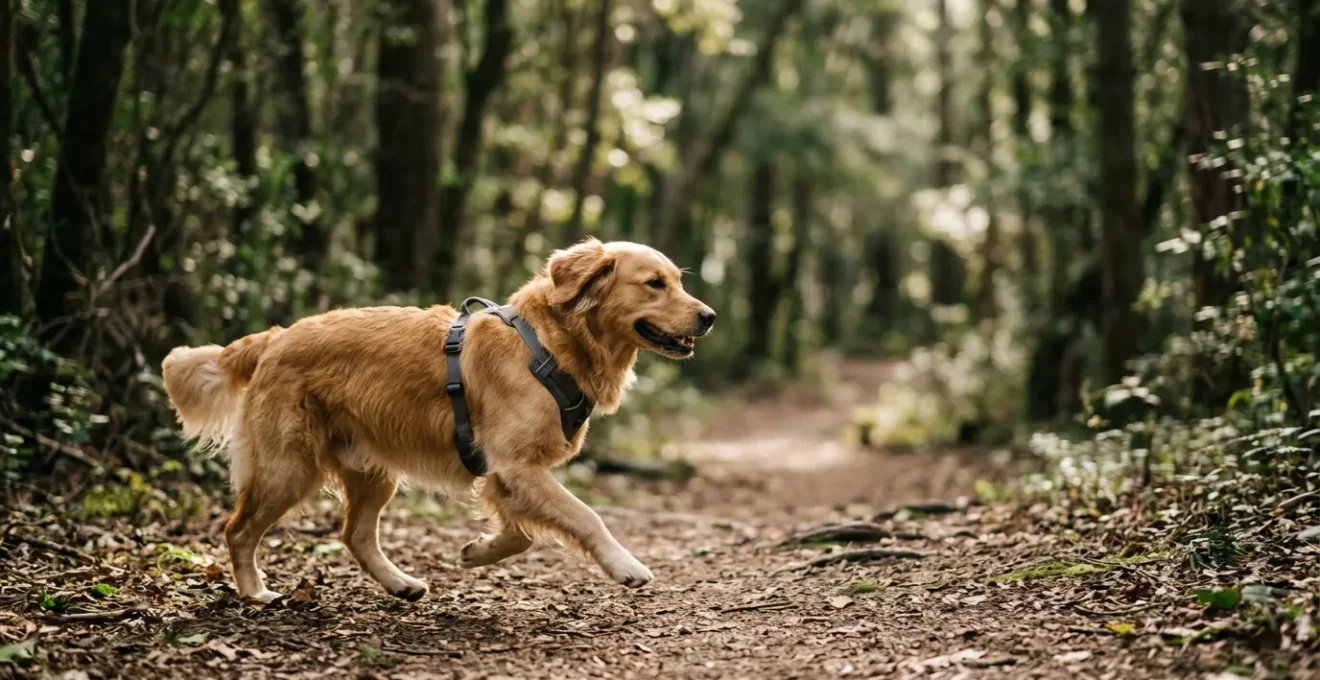
The choice between a Y-harness and a Norwegian harness is not a matter of style; it’s a critical decision for your dog’s long-term orthopedic health.
- Norwegian-style “T-bar” straps sit directly across the shoulders, impeding the joint’s natural range of motion, shortening stride, and creating risk for long-term damage.
- A well-fitted Y-harness distributes pressure safely across the sternum (breastbone), leaving the shoulder blades and joints completely free to move as nature intended.
Recommendation: For any dog, but especially for those that pull, selecting a well-fitted Y-harness is the superior choice to ensure both safe control and the preservation of your dog’s biomechanical integrity.
As an owner of a dog that pulls, you’ve likely felt that familiar jolt at the end of the leash and worried about both your arm and your dog’s neck. The search for a better solution often leads to the world of harnesses, where two designs dominate the landscape: the sleek, easy-to-fit Norwegian (or “T-bar”) style and the more complex-looking Y-harness. The common advice often circles around which one “stops pulling” better, but this misses a far more critical question: which one protects your dog’s long-term orthopedic health?
Most discussions remain superficial, comparing aesthetics or ease of use. They fail to look under the fur at the intricate system of bones, muscles, and ligaments that power your dog’s every movement. This article moves beyond simple preference. We will dissect the canine anatomy and apply principles of sports medicine to demonstrate, with clinical clarity, why the Y-harness is not just a different option, but a fundamentally superior one for preserving your dog’s shoulder mobility and overall biomechanical integrity.
We’ll explore the hidden dangers of horizontal straps, pinpoint the exact anatomical landmarks for a perfect fit, and explain the physics that make one design escape-proof and the other a liability. This is not just a gear review; it’s an investment in your dog’s future comfort and mobility.
This comprehensive analysis will guide you through the critical anatomical and functional differences between these harness types. Below is a summary of the key areas we will cover to provide you with the knowledge to make the safest choice for your companion.
Summary: The Expert’s Guide to Canine Harnesses and Shoulder Biomechanics
- The “T-Shape” Danger: How Horizontal Straps Block the Shoulder?
- High or Low: Where Should the Y Sit on the Sternum?
- How the Y-Design Prevents Backing Out Compared to Step-Ins?
- Grow-With-Me: Which Y-Harnesses Offer the Best Adjustment Range?
- Neoprene vs. Mesh: Which Padding Prevents Chafing in Wet Weather?
- How Restrictive Harnesses Shorten Your Dog’s Stride Length?
- Head Halter vs. Harness: Which Is Safer for a Throat-Sensitive Puller?
- The 2-Finger Rule: Is Your Harness Too Loose or Constricting?
The “T-Shape” Danger: How Horizontal Straps Block the Shoulder?
The primary flaw of the Norwegian-style harness is its most defining feature: the horizontal strap that runs directly across the dog’s chest, creating a “T-shape” with the back strap. From a biomechanical perspective, this design is fundamentally at odds with canine anatomy. The dog’s shoulder is a complex ball-and-socket joint designed for a wide range of motion, particularly fore-and-aft extension and flexion during gait. The horizontal strap of a Norwegian harness sits directly on top of the key muscles and bones responsible for this movement, including the supraspinatus and biceps tendons.
When the dog moves, especially when pulling, this strap acts as a restrictive band. It physically blocks the full extension of the shoulder, a phenomenon known as shoulder impingement. Instead of gliding freely, the joint is forced to operate in a compressed, limited range. Scientific research confirms this; studies show restrictive harnesses can shorten a dog’s forelimb motion by 10-30%. Further data indicates that chest strap harnesses specifically reduce shoulder extension by up to 8-10 degrees, a significant deficit when repeated over thousands of steps.
This constant restriction doesn’t just feel “annoying” for the dog; it forces compensatory movements. The dog may shorten its stride, turn its elbows out, or put more strain on its back and hind limbs to make up for the lack of front-end power. Over time, this can contribute to repetitive strain injuries, muscle imbalances, and potentially aggravate conditions like arthritis. As renowned trainer Lez Graham notes after reviewing biomechanics research, “Harnesses change how dogs move and have a significant negative impact on our dog’s action and gait… even when there is no lead tension.” In contrast, the Y-harness is designed to avoid this entire conflict by fitting around the shoulder assembly, not across it.
High or Low: Where Should the Y Sit on the Sternum?
Unlike the Norwegian harness, which creates conflict with the shoulders, the Y-harness is designed to work in harmony with the dog’s anatomy. Its effectiveness, however, is entirely dependent on correct placement. The key to a proper fit is the location of the central “Y” junction. This junction must sit squarely on the manubrium, which is the prominent, uppermost part of the dog’s sternum (breastbone). You can easily feel this bone at the base of the throat where the chest begins.
When positioned correctly, the manubrium acts as the perfect sternum anchor point. It’s a strong, stable bone structure capable of distributing pressure evenly and safely, away from the soft tissues of the throat and the mobile joints of the shoulders. If the Y-junction is too high, it can press on the trachea, defeating one of the main purposes of using a harness over a collar. If it’s too low, it begins to creep down between the front legs, potentially restricting leg movement and allowing the neck straps to slip upwards and interfere with the shoulder points.
The “Y” shape of the neck straps should form a perfect cradle around the shoulder blades, allowing them to move backward and forward without any fabric blocking their path. Achieving this perfect fit requires careful adjustment and an understanding of how a harness interacts with different body shapes. The following checklist provides a systematic way to ensure an optimal, safe fit.
Your 5-Point Fit Check for Y-Harness Positioning
- Y-Junction Placement: Ensure the Y-junction sits directly on the manubrium (uppermost part of sternum).
- Neck Straps Check: Verify straps don’t impinge on shoulder points. The shoulder blades should move freely under the straps.
- Girth Strap Position: Maintain a width of 2-3 fingers between the strap and the back of your dog’s armpit to prevent chafing.
- Back Strap Stability: Check that the back piece and leash connection point do not twist or slide excessively to one side during movement.
- Dynamic Movement Test: After fitting, walk your dog for at least five minutes and then check for any red marks, rubbing, or shifts in harness position.
Different canine body shapes present unique fitting challenges. A harness that fits a broad-chested Bulldog perfectly might be unsuitable for a deep-chested Greyhound. The following table breaks down common fitting issues for various breed types and how to address them.
| Breed Type | Ideal Y-Position | Common Mistake | Adjustment Tip |
|---|---|---|---|
| Deep-chested (Greyhound) | Higher on manubrium | Sitting too low | Prioritize neck fit over girth |
| Broad-chested (Bulldog) | Centered on sternum | Too tight on chest | Use wider chest piece |
| Narrow-bodied (Yorkie) | Slightly lower positioning | Neck opening too wide | Focus on snug neck adjustment |
How the Y-Design Prevents Backing Out Compared to Step-Ins?
A common and terrifying scenario for any dog owner is the “backing out” escape, where a spooked or stubborn dog simply reverses, leaving the harness dangling from the leash. This is a notorious flaw in many step-in and Norwegian-style harnesses. The Y-harness design, when properly fitted, creates a much more secure system by employing simple but effective principles of physics and anatomy.
The security of a Y-harness lies in its two-point encirclement system. It features one loop around the neck and another around the girth (the deepest part of the chest). When a dog tries to back out, it’s pulling against the girth strap. Because the neck opening is fitted snugly (but not tightly) and sits in front of the wider shoulder structure, the dog cannot easily pull its head and shoulders back through that opening. The escape vector is effectively blocked. The harness tightens around the torso, the most secure part of the dog’s body, rather than slipping over the head.
In contrast, many step-in or T-bar harnesses have a much larger neck/chest opening. When the dog reverses, there is often enough slack and a wide enough gap for the entire harness to slide forward and off. The horizontal chest strap of a Norwegian harness provides a perfect pressure point for the dog to push against as it backs away, effectively shrugging the harness off over its head. The Y-design’s form-fitting nature around the neck and shoulders mitigates this risk significantly.
For truly skilled escape artists, especially those with a narrow chest and large head (like sighthounds), some manufacturers have enhanced this security feature even further. Specialized models add an extra strap that fastens further back on the dog’s abdomen. For instance, some premium brands feature a Y-front with an additional third belly strap for maximum security. This creates a third anchor point behind the rib cage, making it virtually impossible for a dog to back out, as the harness is now secured around the narrowest part of the waist as well as the chest.
Grow-With-Me: Which Y-Harnesses Offer the Best Adjustment Range?
A harness is only as good as its fit, and a perfect fit is impossible without adequate adjustability. This is especially true for growing puppies, dogs with unconventional body proportions, or owners looking for a single harness that can adapt to seasonal weight changes. Y-harnesses, by their nature, tend to offer more points of adjustment than their Norwegian counterparts, but not all Y-harnesses are created equal.
The gold standard for adjustability is a harness with at least five adjustment points: one on each side of the neck, one on each side of the girth, and one on the strap connecting the neck and girth loops. This level of customization allows the owner to fine-tune every aspect of the fit, ensuring the Y sits perfectly on the sternum and the girth strap sits well behind the armpits, regardless of whether the dog has a deep chest and narrow neck or a broad, muscular build.
The quality of the hardware used for these adjustments is just as important as the number of adjustment points. Metal triglides offer superior slip resistance and durability compared to plastic sliders, which can loosen over time, especially when wet. This ensures that once you’ve achieved the perfect fit, it stays that way through vigorous activity.
Case Study: The Impact of Adjustment Points
A 2023 study comparing different Y-harness brands found that designs with 5-6 adjustment points, such as the modular Perfect Fit harness, provided significantly better customization for dogs with unusual proportions compared to standard harnesses with only 2-3 adjustment points. The increased adjustability allowed for a more open shoulder design and a more precise, secure fit, reducing the potential for rubbing and movement restriction.
Beyond the fit, the quality of the adjustment hardware itself is a critical factor in a harness’s longevity and reliability, especially under load or in adverse weather conditions. The following table compares common hardware materials.
| Hardware Type | Slip Resistance | Wet Performance | Durability |
|---|---|---|---|
| Plastic Sliders | Low-Medium | Poor when wet | 2-3 years |
| Metal Triglides | High | Excellent | 5+ years |
| Friction Buckles | Very High | Good | 4-5 years |
Neoprene vs. Mesh: Which Padding Prevents Chafing in Wet Weather?
Even the best-fitting harness can cause discomfort if the material isn’t right for the conditions. For dogs who love to swim, hike in the rain, or simply run through wet grass, material choice becomes a critical factor in preventing painful chafing. The two most common padding materials found in high-quality Y-harnesses are mesh and neoprene, and each has distinct advantages depending on the environment.
Mesh, particularly spacer mesh, is prized for its breathability. The open-weave structure allows for excellent air circulation, making it a fantastic choice for hot, dry weather to help keep the dog cool. However, in wet conditions, this same structure becomes a liability. Most mesh materials are absorbent; they soak up water like a sponge. A waterlogged harness is not only heavy but also creates a high-friction environment. As the dog moves, the wet, abrasive material can rub against the skin, causing irritation and chafing, particularly in sensitive areas like the armpits.
Neoprene, the material used in wetsuits, offers a superior solution for wet weather. It is inherently hydrophobic, meaning it does not absorb water. In fact, high-quality neoprene absorbs less than 5% of its weight in water. This means a neoprene-padded harness will remain lightweight and will not hold moisture against the dog’s skin. It dries quickly and maintains a smooth, low-friction surface even when drenched, dramatically reducing the risk of chafing. While it is less breathable than mesh, its performance in wet and cold conditions is unparalleled.
Choosing the right material is a matter of matching it to your dog’s primary activities. A strategic material choice is essential for year-round comfort. Here is a quick guide:
- Neoprene: Best for swimming, water sports, rainy or snowy conditions. Its waterproof and quick-drying nature is ideal.
- Lightweight Mesh: Perfect for hot, dry climates and activities where maximum breathability is the priority.
- Spacer Mesh with Perforation: A good compromise for mixed conditions, offering ventilation in key heat zones.
- Fleece or Soft-shell: Ideal for dogs with very sensitive skin, but only in cool, dry weather as it can get waterlogged and hold debris.
- Crucial Tip: Avoid any absorbent mesh material in muddy conditions. Trapped grit turns the harness into a “sandpaper effect,” causing severe skin abrasion.
How Restrictive Harnesses Shorten Your Dog’s Stride Length?
The impact of a restrictive, Norwegian-style harness extends far beyond just the shoulder joint. A dog’s body moves as a single, interconnected system, often referred to as the kinetic chain. When one part of this chain is inhibited, it triggers a cascade of compensations throughout the rest of the body. The shortening of the forelimb stride caused by a T-bar harness is a prime example of this principle in action.
A dog’s natural, efficient trot or run relies on a balanced and symmetrical gait. The front legs reach forward to pull the body along, while the rear legs push off to provide power. The length of this forward reach is the “stride length.” When a horizontal strap blocks the shoulder from full extension, it mechanically shortens this stride. The dog simply cannot reach as far forward as it normally would. To maintain its speed, the dog must now compensate.
Common compensations include: taking more frequent, choppier steps; over-using the rear legs to generate more push, which can strain the lower back and hips; or altering the movement of the spine, sometimes leading to a “crabbing” or sideways gait. This unnatural movement pattern is inefficient and places abnormal stress on joints and muscles that weren’t designed for that load. Over months and years, this can contribute to premature arthritis, spinal issues, or soft tissue injuries. The Y-harness, by preserving the natural stride length, helps maintain the integrity of the entire kinetic chain, ensuring a healthier, more balanced movement pattern for the life of the dog.
Head Halter vs. Harness: Which Is Safer for a Throat-Sensitive Puller?
For owners of powerful pullers, especially those with sensitive throats or conditions like tracheal collapse, the choice often narrows to a head halter or a body harness. While a head halter can be an effective training tool for stopping pulling, it comes with its own set of significant safety concerns that are often overlooked. From a biomechanical safety standpoint for a throat-sensitive dog, a Y-harness is the clear winner.
A head halter functions by applying pressure to the dog’s muzzle and the back of its head. The principle is simple: where the head goes, the body will follow. While this provides excellent control, it also concentrates all the force of a lunge or a sudden pull directly onto the dog’s head and cervical spine (neck). A sudden jerk on the leash when a dog is wearing a head halter can cause a dangerous whiplash-like injury to the neck. A 2019 systematic review highlighted that while head halters provide control, significant questions remain about their long-term suitability and the potential for cervical spine stress.
The Y-harness, in stark contrast, completely bypasses the neck as a point of control. All leash pressure is distributed across the dog’s strong sternum and rib cage, areas far more capable of handling force than the delicate structures of the neck. For a dog with a collapsing trachea, brachycephalic syndrome, or any laryngeal sensitivity, this is not just a preference—it is a critical safety requirement. A Y-harness allows for safe management of a pulling dog without any risk of putting pressure on the airway or cervical spine.
While some may argue for front-clip harnesses, which also redirect pulling, the Y-shape remains superior for preserving natural gait compared to many front-clip designs that can also cause the dog to walk asymmetrically. Ultimately, when the primary concern is protecting a sensitive throat and neck, the Y-harness provides the safest combination of pressure distribution and biomechanical freedom.
Key Takeaways
- Anatomy is Non-Negotiable: Norwegian-style harnesses with a horizontal strap directly conflict with the natural movement of a dog’s shoulder joint, leading to restricted stride and potential long-term orthopedic issues.
- The “Y” is for “Why It Works”: A Y-harness is designed to fit around the shoulder assembly, anchoring on the strong sternum (breastbone) and leaving the shoulder blades completely free to move.
- Fit is Everything: A Y-harness’s effectiveness depends on the central junction sitting on the manubrium (upper sternum) and the girth strap being 2-3 fingers’ width behind the armpits.
The 2-Finger Rule: Is Your Harness Too Loose or Constricting?
The “two-finger rule”—the advice that you should be able to fit two fingers under the harness straps—is a widely circulated but overly simplistic guideline. While it provides a starting point, it fails to account for the vast differences in dog size, coat thickness, and body shape. For a Great Dane, two fingers might mean the harness is dangerously loose, while for a Chihuahua, it could be uncomfortably tight. A truly safe and secure fit requires a more nuanced assessment that goes beyond this one-size-fits-all rule.
A better approach is to perform a series of functional tests. A properly fitted harness should be snug, but not constricting. It should not rotate or shift more than an inch to either side when you apply gentle pressure. You shouldn’t be able to pinch a fold in the webbing; if you can, it’s too loose. Most importantly, the harness should not alter the dog’s natural gait. Observe your dog walking and trotting; if you see any change in their movement, the harness is likely too tight or is restricting them somewhere.
Ultimately, the most critical element for both safety and comfort is the fit of the neck opening. According to canine gear experts, the most critical safety factor is the neck opening fit. If the neck opening is too large, it allows the harness to slip, potentially interfering with the shoulders or, in a worst-case scenario, allowing the dog to escape. If it’s too small, it will constrict the throat. The neck straps should follow the line of the shoulders without gaping or digging in, ensuring the harness stays securely in its biomechanically correct position.
Instead of relying solely on the 2-finger rule, use this more comprehensive checklist for a truly secure fit:
- Fabric Fold Test: When the harness is on, try to pinch a fold of the webbing on the back or chest strap. If you can, it’s too loose.
- Rotation Test: Gently pull the harness from side to side. It should not rotate more than an inch in either direction.
- Escape Test: Apply gentle, steady backward pressure on the leash. The harness should tighten slightly but not slip forward over the shoulders.
- Movement Test: Watch your dog walk and trot. There should be no visible alteration to their stride, no pinching, and no awkward limb movements.
- Breed-Specific Adjustment: Remember that giant breeds may need more than two fingers’ space for comfort, while tiny breeds may need less than one. Adjust based on the functional tests, not a rigid rule.
Frequently Asked Questions on Why Y-Harnesses Are Superior to Norwegian Styles for Shoulder Health?
Can head halters cause eye injuries?
Yes, there’s a lesser-known danger of head halter straps riding up and rubbing on or injuring the dog’s eyes, a risk that is non-existent with body harnesses.
What’s the difference in training philosophy between head halters and front-clip harnesses?
Head halters work via negative reinforcement (pressure is applied to the muzzle and released when the dog stops pulling), which can be aversive for some dogs. Front-clip harnesses work by redirecting momentum—when the dog pulls, the leash attachment point on the chest gently turns them back toward you. This makes the front-clip harness a more cooperative and less intrusive training tool for many dog-handler teams.
By understanding the fundamental biomechanics of canine movement, you can now see that the choice of a harness is a significant health decision. The anatomical evidence is clear: the Y-harness is the only design that respects and preserves the natural function of your dog’s shoulder. By choosing a well-fitted Y-harness, you are not just selecting a piece of equipment for control; you are making a proactive investment in your dog’s long-term comfort, mobility, and orthopedic well-being. Now that you are equipped with this knowledge, the next step is to critically evaluate your own equipment. Assess your current harness not for its color or brand, but for its impact on your dog’s every step.