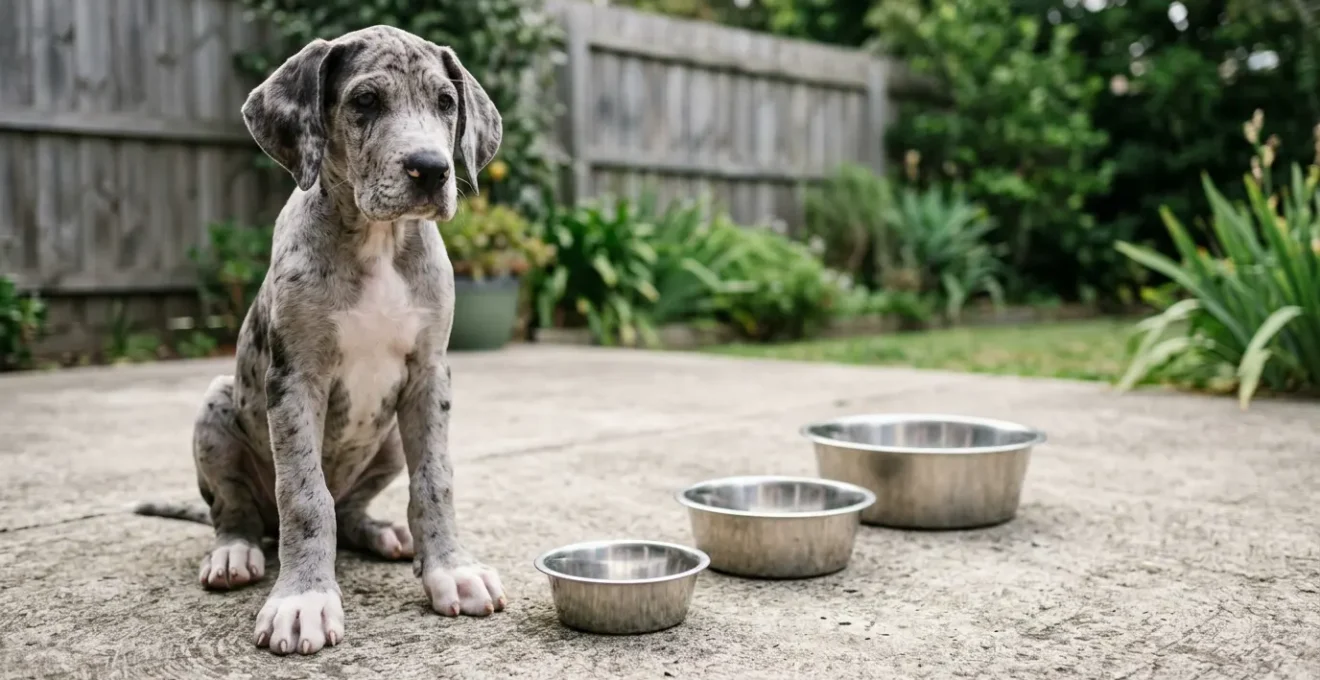
Feeding a Great Dane puppy an “all-life-stages” food isn’t a safe compromise; it’s a nutritional gamble against their specific genetic code for growth.
- Their rapid growth requires precise, controlled calcium levels that “all stages” formulas often exceed, risking severe developmental orthopedic disease.
- Nutrient needs are dictated by non-negotiable metabolic windows (puppy, adult, senior) that generic, one-size-fits-all foods ignore.
Recommendation: Always select a formula specifically designated for the “growth of large size dogs (70 lbs. or more as an adult)” to match their unique biological timeline and protect their long-term health.
As a new Great Dane owner, the wall of dog food bags is bewildering. Amidst the chaos, the promise of an “All Life Stages” formula seems like a beacon of simplicity: one food for life, from rambunctious puppy to gentle giant. It feels convenient, economical, and logical. After all, a dog is a dog, right? This widespread belief is precisely where a critical, and potentially damaging, misunderstanding of canine biology begins. The marketing of these foods preys on a desire for simplicity, suggesting a universal nutritional solution exists.
But what if the very concept of a single food for all life stages is fundamentally flawed, especially for a breed engineered for such extreme growth? If the key to a long, healthy life for your Great Dane wasn’t about finding a generic “good food,” but about understanding the concept of chrononutrition—feeding according to specific, non-negotiable biological timelines? The truth is, a Great Dane puppy’s body operates on a completely different metabolic clock than an adult or senior dog. Ignoring these distinct metabolic windows isn’t just a missed opportunity; it’s actively providing the wrong nutritional signals at the most critical moments of development.
This article moves beyond the marketing slogans to reveal the veterinary science behind canine nutrition. We will deconstruct why a one-size-fits-all approach fails breeds with specialized genetics. We will explore the precise nutrient dosing required during a Great Dane’s explosive growth phase, examine how needs change with life events like spaying, and contrast these needs with those of other breeds to prove that specificity is not a luxury—it’s a biological necessity. By the end, you will be equipped to read a food label not as a consumer, but as an informed advocate for your puppy’s health, ensuring their diet supports, rather than sabotages, their genetic potential.
To navigate this crucial topic, this guide breaks down the science into clear, understandable sections. The following summary outlines how we will explore the precise nutritional requirements that make breed- and age-specific diets a non-negotiable aspect of responsible ownership.
Summary: A Vet’s Perspective on Breed-Specific Nutrition
- How to Cut Calories After Spaying Without Leaving Your Dog Hungry?
- Border Collie vs. Bulldog: Why Their Protein Needs Differ by 30%?
- The Calcium Ratio That Protects Large Breed Joints During Growth
- At What Age Should You Actually Switch to a “Mature” Diet?
- Why Dalmatians Need Low-Purine Diets to Avoid Stones?
- Loving a Dog That Only Lives 8 Years: The Emotional Reality
- Why Your Chihuahua Shakes and How frequent Meals Fix It?
- How to Choose a Puppy Formula That Supports Brain and Bone Development?
How to Cut Calories After Spaying Without Leaving Your Dog Hungry?
A major life event like spaying or neutering triggers an immediate and permanent shift in a dog’s metabolic rate, a change that an “all life stages” food is completely unequipped to handle. The hormonal shifts following the procedure cause a significant metabolic slowdown. In fact, research from PMC shows a potential 30% reduction in daily caloric needs. Continuing to feed the same “all stages” portion post-surgery is a direct path to obesity and its associated health problems, such as joint stress and diabetes.
This isn’t simply a matter of feeding less; that would leave a hungry, dissatisfied dog. The strategic veterinary approach involves reformulating the diet itself. The goal is to decrease caloric density while maintaining or even increasing meal volume to promote satiety. This is achieved by incorporating high-fiber, low-calorie ingredients like green beans or pumpkin into their meals. This adds bulk and helps the dog feel full without excess calories.
Furthermore, adjusting the feeding schedule can manage hunger. Instead of one or two large meals, dividing the daily ration into three or four smaller meals helps stabilize blood sugar and prevent the “starving” sensation that leads to begging. This demonstrates a core failure of the “all life stages” philosophy: nutrition isn’t static. It must be dynamically adjusted in response to major biological changes, proving that a single, unchanging formula cannot adequately support a dog’s health throughout its entire life.
Border Collie vs. Bulldog: Why Their Protein Needs Differ by 30%?
The concept of a single food for all dogs crumbles when examined at the level of breed-specific genetics and muscle physiology. Consider two distinct breeds: the Border Collie, an endurance athlete, and the Bulldog, a power-based brachycephalic breed. Their dietary needs are not interchangeable because their bodies are fundamentally different tools designed for different jobs. A Border Collie’s musculature is dominated by slow-twitch muscle fibers, which are efficient at using fat and oxygen for sustained, lower-intensity activity. A Bulldog, conversely, has a higher proportion of fast-twitch muscle fibers, built for short bursts of power and requiring more readily available energy from protein and carbohydrates.
This physiological difference directly translates to varying protein and amino acid requirements. An “all life stages” food, which typically offers a moderate protein percentage to serve as a common denominator, under-serves the Bulldog’s need for muscle density and over-serves the less-demanding requirements of a more sedentary Collie, potentially leading to excess kidney strain over time.
This table illustrates how profoundly their protein needs diverge based on their genetic purpose and muscle composition. An “all life stages” food, by its very nature, ignores these critical distinctions.
| Breed Type | Muscle Fiber Type | Protein % | Key Amino Acids |
|---|---|---|---|
| Border Collie (Endurance) | Slow-twitch dominant | 22-24% | BCAAs for recovery |
| Bulldog (Power) | Fast-twitch dominant | 26-28% | Glutamine for muscle density |
| Activity Impact | Metabolic Rate | +/- 30% | Variable needs |
This is a clear biological argument against a one-size-fits-all diet. If two common breeds have such drastically different needs, it’s biologically illogical to assume one formula could optimally nourish a rapidly growing Great Dane, a tiny Chihuahua, and every breed in between.
The Calcium Ratio That Protects Large Breed Joints During Growth
For a Great Dane puppy, no nutritional factor is more critical—or more dangerous when mismanaged—than calcium. Their genetic code dictates an explosive growth rate, where they can gain over 100 pounds in their first year. During this period, their skeletal system is incredibly vulnerable. Unlike adult dogs, puppies under six months cannot regulate how much calcium they absorb from their intestines. Instead, veterinary research confirms up to 70% passive calcium absorption, meaning if there’s excess calcium in their food, their body will absorb it, whether it’s needed or not.
This is where “all life stages” foods pose a direct threat. Formulated to meet the needs of lactating females, they often contain higher levels of calcium. When a Great Dane puppy consumes this excess calcium, it accelerates bone growth beyond what their cartilage and soft tissues can support. This asynchronous growth is a primary cause of Developmental Orthopedic Disease (DOD), a category of crippling conditions including Hypertrophic Osteodystrophy (HOD) and Osteochondritis Dissecans (OCD). The puppy’s bones literally outgrow their own structural integrity.
To prevent this, veterinary nutritionists have established strict guidelines. As detailed by VCA Hospitals, large breed puppies require a precise calcium-to-phosphorus ratio between 1.1:1 and 1.4:1, with total calcium levels between 0.8% and 1.2% (dry matter basis). This narrow window is non-negotiable. Foods that meet this standard will carry a specific AAFCO nutritional adequacy statement: “formulated to meet the nutritional levels established by the AAFCO Dog Food Nutrient Profiles for growth of large size dogs (70 lbs. or more as an adult).” An “all life stages” label is an admission that it does not meet this specialized, protective requirement.
At What Age Should You Actually Switch to a “Mature” Diet?
The term “senior” is another area where the “all life stages” concept oversimplifies canine biology. There is no universal age at which a dog becomes a senior. The aging process is directly correlated with breed size and life expectancy. A Great Dane is considered a senior at age 5 or 6, while a Chihuahua doesn’t enter its golden years until age 10 or later. An “all life stages” diet, which provides a consistent nutritional profile, completely fails to adapt to the changing metabolic needs of an aging dog, whether that aging begins at year 5 or year 10.
As a giant breed with a compressed lifespan, a Great Dane’s transition to a “mature” or “senior” diet is critical and happens much earlier than most owners expect. Senior diets are formulated differently; they often contain fewer calories to prevent age-related weight gain, increased fiber for digestive health, and specific nutrients like glucosamine and chondroitin for joint support. Keeping a 6-year-old Great Dane on a high-calorie “all stages” formula is a recipe for obesity and exacerbated arthritis.
| Breed Size | Adult Weight | Senior Age Begins | Life Expectancy |
|---|---|---|---|
| Giant (Great Dane) | 110-175 lbs | 5-6 years | 7-10 years |
| Large | 50-90 lbs | 7 years | 10-13 years |
| Small/Toy | Under 25 lbs | 10+ years | 12-16 years |
Rather than relying on a single number, the transition should be guided by biological markers. Observing your dog for the subtle signs of aging is a far more accurate method than consulting a calendar. This requires active, engaged ownership, not passive reliance on a generic food bag.
Your Action Plan: Identifying Biological Markers for a Diet Transition
- Monitor for early signs of graying fur around the muzzle and eyes.
- Check for decreased activity levels or new reluctance to jump on furniture or into the car.
- Watch for changes in sleep patterns, such as more frequent or longer naps.
- Assess their body condition score monthly, paying close attention to any tendency for weight gain.
- Note any stiffness or slow movements, particularly after periods of rest.
Why Dalmatians Need Low-Purine Diets to Avoid Stones?
The Dalmatian provides one of the most compelling genetic arguments against “all life stages” food. This breed possesses a unique and problematic genetic mutation that affects how their body processes purines, which are organic compounds found in many protein sources. Unlike almost all other dog breeds, Dalmatians cannot efficiently convert uric acid (a byproduct of purine metabolism) into a soluble compound called allantoin. This is not a rare issue; genetic studies confirm that virtually 100% of Dalmatians carry the SLC2A9 gene mutation that causes this metabolic defect.
As a result, they excrete high levels of uric acid in their urine, putting them at an extremely high risk for forming painful urate bladder stones. For a Dalmatian, diet is not just nutrition; it is preventative medicine. They require a diet specifically low in purines to manage this lifelong genetic predisposition. “All life stages” foods, especially those high in protein from sources like organ meats or certain fish, can be dangerously high in purines. Feeding such a diet to a Dalmatian is actively contributing to the formation of stones.
A responsible diet for a Dalmatian involves a carefully curated list of ingredients, prioritizing low-purine proteins and ensuring high levels of hydration to keep the urine dilute. This level of specialization is the antithesis of the “all life stages” philosophy.
- Low-Purine Foods (Safe): Eggs, cottage cheese, rice, most vegetables and fruits.
- Moderate-Purine Foods (Use Sparingly): Chicken, turkey, most white fish, lamb.
- High-Purine Foods (Avoid): Organ meats (liver, kidney), sardines, mackerel, game meats, and beef.
The Dalmatian’s case is a stark reminder that a dog’s breed is a roadmap to its internal biology. Ignoring that map in favor of a generic “one-size-fits-all” path can lead to predictable and painful health crises.
Loving a Dog That Only Lives 8 Years: The Emotional Reality
Owning a Great Dane is an exercise in loving a life lived in fast-forward. Their tragically short lifespan of just 7-10 years means every nutritional choice carries immense weight. The puppy phase, which feels fleeting, is the single most important metabolic window for establishing a foundation for longevity. As the Great Dane Club of America poignantly states, the biological reality is that, “Your puppy will grow as much in his first year as a child grows in fourteen years”. This incredible acceleration means there is zero room for nutritional error. Every meal either builds a strong, resilient frame or contributes to the weaknesses that will shorten their life.
This is the emotional core of the argument against “all life stages” food. Choosing a generic diet during this critical first year is a gamble with the most precious commodity you have: time with your dog. When the stakes are this high, convenience is a poor trade for health. Proper nutrition during puppyhood and throughout their life isn’t just about preventing disease; it’s about maximizing the quality and quantity of the years you have together.
The connection between diet and lifespan is not just theoretical. While genetics play the largest role, targeted nutrition is the most powerful tool an owner has to influence it. For Great Danes, a precisely formulated large-breed puppy diet that protects their joints, followed by an appropriate adult and early senior diet, is paramount. Many feeding experts suggest that 1-2 years can be added to a giant breed’s life with optimal nutrition and lean body conditioning. Opting for a specialized diet is an investment that pays dividends in shared moments, healthy activity, and the profound joy of a few more cherished years.
Why Your Chihuahua Shakes and How frequent Meals Fix It?
Just as a one-size-fits-all diet fails giant breeds, it also fails toy breeds like the Chihuahua, but for precisely the opposite reasons. A Chihuahua’s shaking is often not a sign of fear or cold, but a symptom of hypoglycemia, or low blood sugar. This condition is a direct result of their unique physiology: a tiny body with an extremely high metabolic rate and minimal glycogen (stored energy) reserves in their small liver. As the American Kennel Club’s veterinary experts document, a toy breed puppy can require twice the calories per pound as an adult dog just to function.
An “all life stages” food, fed in two standard meals per day, is a dangerous protocol for a Chihuahua puppy. A single missed meal or a long gap between feedings can deplete their energy reserves, leading to a hypoglycemic crisis. Symptoms include lethargy, stumbling, and in severe cases, seizures. The emergency fix—rubbing honey or corn syrup on their gums—highlights how precarious their energy balance is. The preventative solution is a diet strategy built around frequent, small, calorie-dense meals to provide a constant stream of energy.
This need for a continuous energy supply is fundamentally at odds with the “all life stages” model. A food designed to be a “middle ground” for a 70-pound Labrador and a 5-pound Chihuahua will inevitably fail both. The Chihuahua needs caloric density and frequent feeding, while the large breed needs caloric control and specific mineral ratios. They are on opposite ends of the metabolic spectrum, proving that tailoring nutrition to a dog’s size and metabolism is essential for their immediate safety and long-term health.
Key Takeaways
- Chrononutrition is key: A dog’s nutrient requirements are dictated by specific, time-sensitive metabolic windows (puppy, adult, senior) that generic diets ignore.
- Large breed puppy growth is a vulnerability: Their rapid skeletal development requires a precisely controlled, lower-calcium diet to prevent crippling joint diseases.
- Genetics determine diet: A dog’s breed is a blueprint for its metabolic needs, making breed-specific or size-specific formulas a biological necessity, not a luxury.
How to Choose a Puppy Formula That Supports Brain and Bone Development?
Choosing the right food for your Great Dane puppy means becoming a detective, looking past the enticing photos on the bag and focusing on the guaranteed analysis and ingredient list. Your goal is to find a formula that explicitly acknowledges and caters to the unique demands of a giant breed’s growth. As VCA Hospitals confirms, large breeds can take up to 24 months to reach their full adult weight, a period during which their brain and skeleton undergo massive development that requires specific nutritional support.
The first and most important step is to find the AAFCO nutritional adequacy statement. You must ignore any bag that says “all life stages” and find the precise wording: “formulated for the growth of large size dogs (70 lbs. or more as an adult).” This is your guarantee that the manufacturer has formulated the food to meet the strict calcium and phosphorus limits necessary to protect your puppy’s joints.
Next, look for key ingredients that support development. For cognitive health, look for a source of DHA (docosahexaenoic acid), a crucial omega-3 fatty acid for brain and vision development. The best sources are marine-based, such as fish oil or algae, and should be listed within the first few ingredients. For bone development, beyond the critical calcium and phosphorus ratio, the formula should contain supportive minerals like manganese and copper, along with appropriate levels of Vitamin D. Finally, assess the protein source. Look for high-quality, named animal proteins like “deboned chicken” or “lamb meal” as the first ingredient, not vague terms like “meat and bone meal” or a grain like corn.
Now that you are equipped with the science, the next logical step is to apply this knowledge every time you shop. By prioritizing a diet formulated for your Great Dane’s specific life stage and size, you are making the single most impactful decision for their long-term well-being.